A Guide for Foreign Creditors
Nov 6, 2026
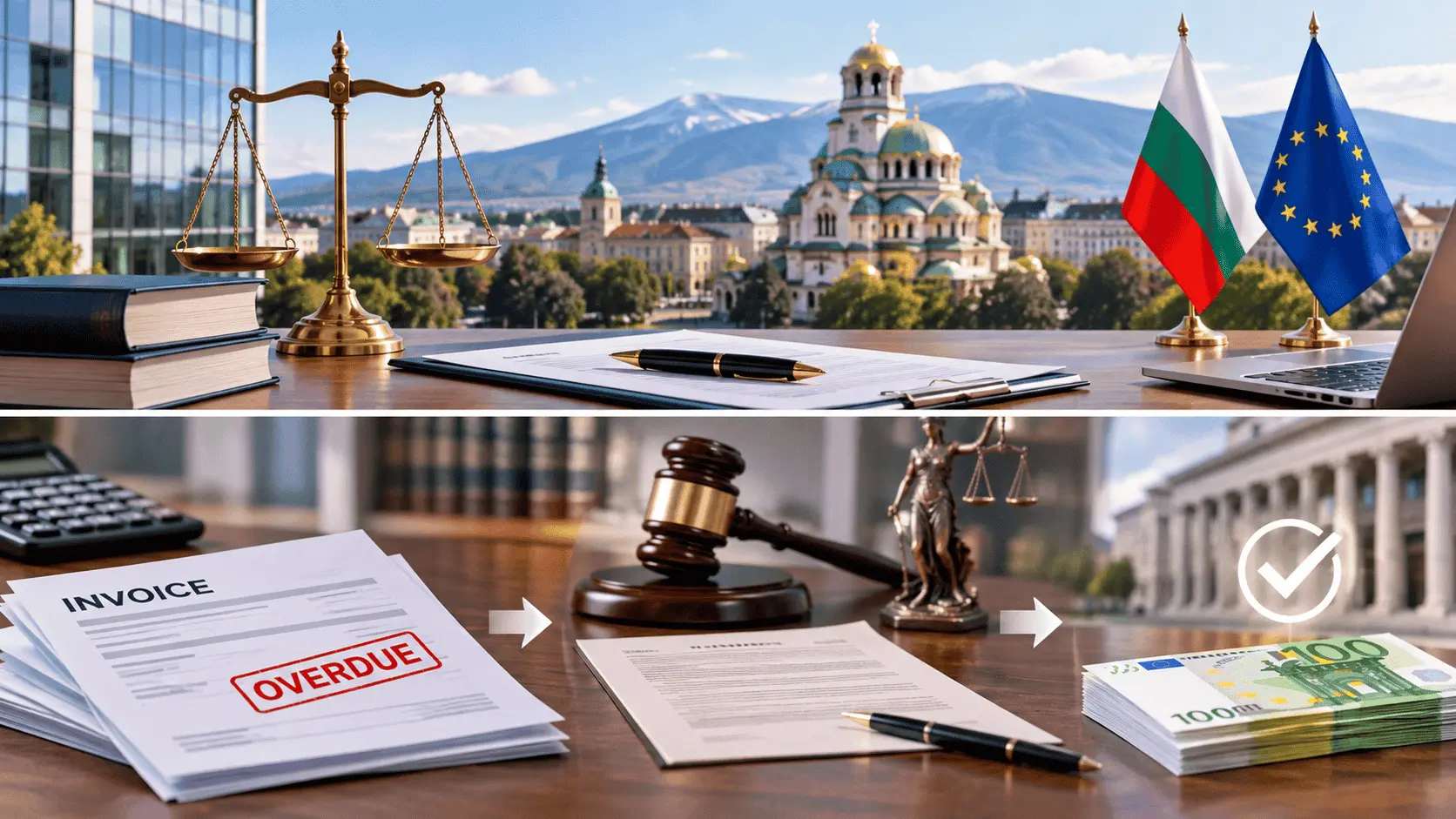
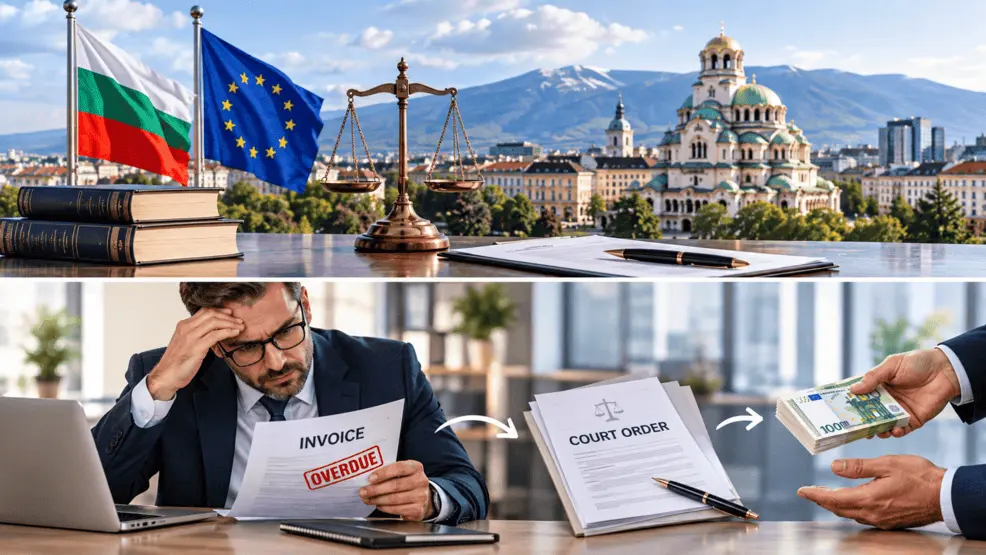
Debt collection in Bulgaria takes three moves for a foreign company with an unpaid invoice from a Bulgarian customer: a formal demand, a fast-track court order, and enforcement by a Bulgarian bailiff. Most B2B claims never need a full trial. The decisions that matter are made early: which procedure you file in, whether you freeze the debtor’s money first, and whether your documents are ready in Bulgarian.
This guide is written for creditors based in Germany, Italy, Greece, Romania, the UK, China, the US and elsewhere who sell to Bulgarian companies. It complements our overview of debt recovery and collection in Bulgaria and our guide to keeping control of B2B receivables.
The short answer
- Bulgaria uses the euro since 1 January 2026. Claims, court fees and enforcement are now in EUR, so there is no currency conversion step.
- Start with a written demand in English and Bulgarian. It costs little and fixes the date from which default interest and costs are argued.
- For an undisputed debt, use the Bulgarian order for payment. It is the fastest court route against a debtor registered in Bulgaria.
- The EU tools (European Payment Order, Small Claims) are alternatives, useful mainly when your own courts have jurisdiction.
- A judgment from another EU country is enforced in Bulgaria without exequatur. UK and other non-EU judgments need a recognition step first.
- Enforcement is done by a bailiff you choose. Bank account garnishment is usually the fastest way to cash.
- Act within the limitation period: generally 5 years for the principal, 3 years for interest.
Step 1: Check the debtor and your file before you act
Spend one day on checks before you send anything. What you find decides the whole strategy, and most of it is public and free.
Check the debtor in the Commercial Register. Every Bulgarian company has a 9-digit UIC (EIK). Search it in the Commercial Register of the Registry Agency. You will see:
- the exact legal name, registered seat and managing director (you need the correct seat to file in the right court);
- whether the company is in liquidation or insolvency, which changes the procedure completely (see Special situations below);
- recent changes of owner, manager or seat, which can signal an attempt to escape creditors;
- published annual financial statements, which show whether there are assets worth pursuing.
Check your own documents. Bulgarian courts decide on paper. Before you escalate, collect:
- the contract, order confirmation or accepted general terms, including any clause on jurisdiction, governing law and interest;
- invoices showing the debtor’s UIC and VAT number;
- proof of delivery or acceptance: signed CMR, delivery notes, acceptance protocols, emails confirming receipt;
- any written acknowledgement of the debt, partial payment or payment promise;
- all reminders sent, with proof of sending.
Check the limitation period. Under Bulgarian law the general limitation period is 5 years from the due date. Interest, and other periodic payments, expire after 3 years. A written acknowledgement or a court application interrupts the period. If your contract is governed by foreign law, that law may set a different period, so confirm it early.
Decide what the claim is worth pursuing for. Add principal, interest and costs, and compare them with the debtor’s visible assets. A large claim against a company with no property and no turnover may justify an insolvency strategy instead of a collection strategy.
Step 2: Amicable recovery – the demand letter and the payment plan
A formal demand sent from a Bulgarian law firm, in Bulgarian, settles a large share of B2B debts without court. Bulgarian managers react differently to a letter on a local lawyer’s letterhead that names the court procedure than to reminders from a foreign accounts department.
What the demand letter should contain:
- the exact debtor name and UIC, the invoices and amounts;
- the legal basis (contract or accepted terms);
- interest claimed and how it is calculated;
- a short final deadline, usually 7 to 14 days;
- the next step if unpaid: an order for payment application and enforcement.
Send it by courier or registered mail with proof of delivery, and by email to the addresses used in the business relationship.
Interest you can claim. If the contract sets a default interest rate, that rate applies. If it does not, Bulgarian statutory interest applies. From 1 January 2026 it equals the ECB main refinancing rate plus 8 percentage points. The ECB rate in force on 1 January applies for the first half of the year, and the rate on 1 July for the second half. The daily rate is 1/360 of the annual rate. Older articles that quote the BNB base rate plus 10 points are out of date.
Fixed recovery compensation. Under the EU Late Payment Directive, implemented in the Bulgarian Commercial Act, a business creditor may claim a fixed compensation of at least EUR 40 per late invoice, on top of interest.
Payment plans that are enforceable. If the debtor asks for instalments, do not accept an email promise. Ask for a written acknowledgement of the full debt with an instalment schedule and an acceleration clause, with the debtor’s signature certified by a Bulgarian notary. A notarised acknowledgement is a document under Art. 417 of the Bulgarian Civil Procedure Code. If an instalment is missed, you can obtain an immediately enforceable order (see Step 3). A promissory note (запис на заповед) signed by the debtor, and ideally co-signed by its manager personally, gives the same advantage.
Typical duration: 2 to 6 weeks. If there is no payment and no serious dispute after the final deadline, move to court. Waiting longer usually helps only other creditors.
Step 3: Choose the court route for debt collection
For an undisputed invoice owed by a company registered in Bulgaria, the Bulgarian order for payment is usually the fastest and cheapest route. The EU procedures are useful mainly when your own courts have jurisdiction and you prefer to litigate at home.
| Procedure | Where you file | Best for | Amount | If the debtor objects |
| Order for payment, Art. 410 Civil Procedure Code | District court of the debtor’s registered seat | Unpaid invoices without special documents | Claims within district court jurisdiction (BGN 25,000, about EUR 12,782) | Debtor has 2 weeks to object; you then have 1 month to file a claim under Art. 422 |
| Order for immediate enforcement, Art. 417 Civil Procedure Code | Same court | Notarised acknowledgements, promissory notes, other listed documents | No upper limit | Enforcement continues unless the court stays it; you still file the Art. 422 claim within 1 month |
| European Payment Order (Reg. 1896/2006) | A court with jurisdiction under Brussels Ia, which can be your home court | Uncontested cross-border claims | No limit | Debtor has 30 days to oppose; the case moves to ordinary proceedings |
| European Small Claims (Reg. 861/2007) | A court with jurisdiction under Brussels Ia | Small cross-border claims, written procedure | Up to EUR 5,000 | The court decides on the written file |
| Ordinary claim | Bulgarian district or regional court, depending on the amount | Disputed claims or large amounts without Art. 417 documents | No limit | Full trial, usually 12 to 24 months at first instance |
How the Art. 410 order works in practice. You file a standard-form application. Evidence is not required at this stage. The court decides without a hearing and serves the order on the debtor. If the debtor does not object within 2 weeks, the order becomes final and the court issues a writ of execution. The state fee is 2% of the claim.
Why Art. 417 is stronger. With a document listed in Art. 417, the court issues the order and the writ of execution together. A bailiff can garnish the debtor’s bank accounts before the debtor even learns of the case. This is why we recommend notarised payment plans and promissory notes as security from the start of the relationship.
The deadline creditors most often miss. If the debtor objects, the court instructs you to file a claim under Art. 422 within one month. Miss it, and the order is cancelled. A foreign creditor must therefore have a Bulgarian address for service or a local lawyer who receives court notices and reacts at once.
A jurisdiction clause in favour of your home courts does not automatically block a Bulgarian application, but the debtor may rely on it. Check your terms before choosing the route.
Step 4: You already have a judgment from your own country
How a foreign judgment is enforced in Bulgaria depends on where it was given and when the case started.
| Origin of the judgment | Legal basis | What you need to do in Bulgaria |
| EU Member State | Brussels Ia Regulation (EU) 1215/2012 | No exequatur. Take the judgment and the Art. 53 certificate from the court of origin directly to a Bulgarian bailiff. The debtor can only ask a court to refuse enforcement on limited grounds. |
| European Payment Order or European Enforcement Order | Reg. 1896/2006 or Reg. 805/2004 | Enforced directly, like a Bulgarian title. |
| United Kingdom, proceedings started on or after 1 July 2025 | Hague Judgments Convention 2019 | Recognition and enforcement under the Convention, through a Bulgarian court. |
| United Kingdom, earlier proceedings, and other non-EU countries | Bulgarian Code of Private International Law, Art. 117 and following, or a bilateral treaty (for China, the 1993 treaty) | A court procedure for recognition and permission to enforce, then a writ of execution. |
UK creditors after Brexit. The Hague Judgments Convention 2019 entered into force for the UK on 1 July 2025. It covers judgments from proceedings started after it came into force in both countries. For enforcement in Bulgaria, which applies it as an EU Member State, that means UK proceedings issued on or after 1 July 2025. Older UK judgments go through the national procedure.
What a Bulgarian court checks for non-EU judgments. The court does not review the merits. It checks, in short, that the foreign court had jurisdiction under Bulgarian rules, that the debtor was properly served and could defend itself, that there is no conflicting Bulgarian judgment or earlier pending Bulgarian case, and that recognition does not breach Bulgarian public policy. Plan for several months for this step, and longer if the debtor appeals.
Documents. A certified copy of the judgment showing it is final, an apostille or legalisation where required (not for EU court documents), and a certified Bulgarian translation.
Compare the routes before you sue at home. If you have not yet started proceedings and the debtor’s assets are in Bulgaria, a Bulgarian order for payment is often faster than a home judgment followed by recognition. This is especially true for non-EU creditors.
Step 5: Secure the money and enforce
A court order is worth what you can collect with it. The best results come from creditors who freeze assets early and give the bailiff concrete information.
Freeze bank accounts before the debtor reacts. Two tools exist:
- European Account Preservation Order (Reg. 655/2014). Available in cross-border cases in all EU Member States except Denmark. A creditor from another Member State can apply before proceedings, during them or after judgment. The order is issued without notice to the debtor, so the money cannot be moved first. If you apply before suing, you must start proceedings on the merits within a short deadline.
- Bulgarian interim measures. A Bulgarian court can order a garnishment of accounts or an attachment of property to secure a future or pending claim. The court may require you to provide security. If you secure a future claim, you must then file the claim within the deadline the court sets.
Enforcement by a private bailiff. With a writ of execution, an EU judgment with its Art. 53 certificate, or another enforceable title, you open an enforcement case with a bailiff. Most creditors choose a private bailiff (ЧСИ), who works in the district of the debtor’s seat or assets. The main enforcement methods are:
- garnishment of bank accounts, which is usually the fastest route to cash;
- garnishment of receivables owed to the debtor by its own customers;
- attachment and public sale of vehicles, equipment and stock;
- attachment and public sale of real estate, which takes longest;
- attachment of the debtor’s shares in other companies.
Costs. The creditor advances the bailiff’s fees, which are set by a statutory tariff. They are added to the debt and recovered from the debtor. Ask your lawyer for a cost estimate for your specific claim before opening the case.
What makes enforcement work. Give the bailiff the debtor’s bank details from past payments, names of the debtor’s main customers, known addresses of warehouses and sites, and registered vehicles and property. Stay active: bailiffs act faster on files where the creditor’s lawyer follows up.
Special situations: insolvency, liquidation and asset stripping
When the debtor is in insolvency or liquidation, collection actions give way to strict filing deadlines. Check the Commercial Register for these entries before every step.
The debtor is in insolvency. Individual enforcement stops, and you recover through the insolvency estate. Lodge your claim with the trustee within one month of the entry of the decision opening insolvency in the Commercial Register. A later window exists, but late creditors lose rights over distributions already made. Under the EU Insolvency Regulation (EU) 2015/848, creditors from other Member States can lodge claims with a standard form, but you may be asked for a Bulgarian translation. In practice, use a local lawyer: deadlines run from publication in Bulgarian, not from any notice to you.
The debtor is in voluntary liquidation. The liquidator must invite creditors to declare their claims, and assets cannot be distributed to shareholders before creditors are paid. Declare your claim in writing as soon as you see the liquidation entry. If the company is deleted from the register without paying you, recovery becomes much harder.
Petitioning for the debtor’s insolvency. A creditor with an unpaid commercial claim can ask the Bulgarian court to open insolvency proceedings if the debtor cannot pay its debts. The threat of a petition is a strong lever with a solvent debtor that refuses to pay. Use it only after legal advice: the procedure is collective, and other creditors share the result.
The debtor moved assets to a related company. Transactions that harm creditors can be challenged in court with an action under Art. 135 of the Obligations and Contracts Act (actio pauliana). Insolvency law adds further grounds to set aside transactions made before insolvency. Act fast and collect evidence: dates of the transfer, the buyer, the price and the links between the companies.
Chinese exporters: recovering unpaid deliveries from Bulgarian buyers
For a Chinese supplier, the most reliable route is usually to claim directly in Bulgaria, where the buyer and its assets are. A Chinese judgment can be enforced in Bulgaria under a bilateral treaty, but that adds a recognition step with little practical precedent.
The typical pattern. Goods are shipped on a deposit, with the balance due against a copy of the bill of lading or after arrival. The Bulgarian buyer receives the goods, then stops paying or raises a late quality complaint. The contract often exists only as a proforma invoice and an email or WeChat exchange.
Enforcing a Chinese judgment or award in Bulgaria
| What you hold | Legal basis | Practical note |
| Judgment of a Chinese court | China–Bulgaria Treaty on Judicial Assistance in Civil Matters, signed 2 June 1993, in force since 30 June 1995 | The treaty covers recognition and enforcement of judgments and arbitral awards. No public cases of enforcement between the two countries have been reported, so expect a full Bulgarian court procedure. |
| CIETAC or other arbitral award | New York Convention 1958 (China and Bulgaria are both parties) | Recognition by a Bulgarian court, then enforcement by a bailiff. Usually more predictable than a court judgment. |
| Nothing yet, invoice unpaid | Bulgarian Civil Procedure Code | Demand letter, then an order for payment in Bulgaria (Steps 2 and 3). Often the fastest path. |
Documents from China. China joined the Apostille Convention in November 2023. Powers of attorney and company documents issued in mainland China now need an apostille instead of consular legalisation. All documents need a certified Bulgarian translation. Chinese–Bulgarian translators are few, so English versions of the contract and correspondence save time and cost.
Quality complaints as a defence. China and Bulgaria are both parties to the UN Convention on Contracts for the International Sale of Goods (CISG). Unless your contract excludes it, the CISG applies. A buyer who did not examine the goods and notify defects within a reasonable time loses the right to rely on them. Keep inspection reports, photos at loading and the buyer’s acceptance messages: they are your answer to a late complaint.
Export credit insurance. Many Chinese exporters are insured with Sinosure (China Export & Credit Insurance Corporation). Check your policy before acting: it usually sets deadlines for reporting overdue payments and may require the insurer’s consent before you settle or appoint a lawyer. After paying an indemnity, the insurer typically takes over the claim.
Protecting the next shipment. Before releasing goods on credit to a Bulgarian buyer:
- check the buyer’s UIC, owner, manager and financial statements in the Commercial Register;
- prefer a letter of credit or documentary collection for new buyers;
- add a retention of title clause and a clear interest rate;
- ask for a promissory note signed by the company and, personally, by its manager, which gives you an immediately enforceable title in Bulgaria under Art. 417;
- choose the dispute forum deliberately: a Bulgarian court for collection, or arbitration if you expect complex quality disputes.
Practical requirements: language, documents, costs and timelines
Everything filed with a Bulgarian court or bailiff must be in Bulgarian. Budget for certified translations from the start, and keep originals or certified copies ready.
Language and translation. Contracts, invoices, key emails and foreign judgments need a certified Bulgarian translation. Translation is typically charged per page, so translate only the documents that prove the claim.
Apostille and legalisation. Court documents issued under the EU regulations, such as the Art. 53 certificate, need no apostille. Non-EU judgments and documents signed abroad, such as a notarised power of attorney, usually need an apostille or legalisation.
Power of attorney. Your Bulgarian lawyer needs a written power of attorney from your company. For some steps, a notarised signature is required. Ask for the exact wording before you sign, to avoid signing twice.
Address for service. Bulgarian courts serve documents on the parties. A local lawyer as your address for service avoids delays and missed deadlines.
Typical costs
| Item | Typical amount | Recoverable from the debtor? |
| State fee, order for payment (Art. 410 or 417) | 2% of the claim | Yes, if you win |
| State fee, ordinary claim | 4% of the claim, with the order-for-payment fee credited if you sued under Art. 422 | Yes, if you win |
| Lawyer’s fees | Depends on amount and complexity; agree in writing in advance | Partly, as awarded by the court |
| Bailiff’s fees | Statutory tariff; advanced by the creditor | Yes, added to the debt |
| Translation | Charged per page | Usually yes, as procedural costs |
Typical timelines
| Stage | Typical duration |
| Amicable phase | 2 to 6 weeks |
| Art. 417 order and writ of execution | A few days to a few weeks after filing |
| Art. 410 order, no objection, until writ of execution | 1 to 3 months, mostly depending on service on the debtor |
| Claim under Art. 422 after objection | 12 to 24 months at first instance |
| Recognition of a non-EU judgment | Several months, longer if appealed |
| Bank account garnishment | Weeks, once accounts are identified |
| Sale of real estate | 12 to 24 months |
These are estimates from practice and vary by court, by how quickly the debtor can be served, and by the debtor’s assets.
Common mistakes foreign creditors make
Most failed recoveries we see were lost through timing or paperwork, not on the merits.
- Waiting too long. Months of friendly reminders give the debtor time to pay other creditors first or move assets.
- Suing at home by reflex. A home judgment against a Bulgarian company still has to be enforced in Bulgaria. For an undisputed invoice, a Bulgarian order for payment is often faster.
- Missing the one-month deadline under Art. 422. If the debtor objects and no claim is filed in time, the order for payment is cancelled.
- Accepting informal payment promises. An email promise is weak evidence. A notarised acknowledgement gives you an immediately enforceable title.
- Ignoring the Commercial Register. Missing an insolvency or liquidation entry can cost you the right to be paid from the estate.
- Using an outdated interest rate. Since 1 January 2026, statutory interest is the ECB main refinancing rate plus 8 points, not the old BNB-based formula.
- Leaving the bailiff without information. Without account details, customer names or asset locations, enforcement often ends with nothing collected.
Frequently asked questions
Can a foreign company collect a debt in Bulgaria without a Bulgarian lawyer? It is legally possible, but impractical. All filings must be in Bulgarian, court notices are served in Bulgaria, and deadlines such as the one-month term under Art. 422 run regardless of where you are.
What is the fastest way to recover an unpaid invoice from a Bulgarian company? A formal demand from a Bulgarian lawyer, followed by an order for payment under Art. 410 of the Civil Procedure Code. With a notarised acknowledgement or a promissory note, an Art. 417 order allows immediate enforcement.
Can I use the European Payment Order against a Bulgarian customer? Yes, if a court of an EU Member State has jurisdiction under Brussels Ia. The debtor has 30 days to oppose. Once declared enforceable, the order is enforced in Bulgaria without exequatur.
Is a German, Italian or French judgment enforceable in Bulgaria? Yes. Under the Brussels Ia Regulation, a judgment from another EU Member State is enforced without exequatur. Present the judgment and the Art. 53 certificate to a Bulgarian bailiff.
How do I enforce a UK judgment in Bulgaria after Brexit? For proceedings started on or after 1 July 2025, under the Hague Judgments Convention 2019. For earlier proceedings, under the Bulgarian Code of Private International Law, through a court recognition procedure.
How can a Chinese supplier recover payment from a Bulgarian buyer? Usually by claiming directly in Bulgaria: a demand letter, then a Bulgarian order for payment and enforcement by a bailiff. A Chinese judgment or CIETAC award can also be enforced in Bulgaria, under the 1993 China–Bulgaria judicial assistance treaty or the New York Convention, but only after a Bulgarian court procedure.
What interest can I claim on a late B2B payment in Bulgaria? The contractual rate, if one was agreed. Otherwise statutory interest: the ECB main refinancing rate plus 8 percentage points, fixed for each half-year. You can also claim a fixed compensation of at least EUR 40 per invoice.
How long do I have to start recovery? Generally 5 years from the due date for the principal and 3 years for interest under Bulgarian law. An acknowledgement of the debt or a court application interrupts the period.
Can I freeze a Bulgarian company’s bank account before I sue? Yes. Creditors from other EU Member States can apply for a European Account Preservation Order, and Bulgarian courts can grant interim measures. Both can be obtained without warning the debtor.
What happens if the debtor goes insolvent? Enforcement stops, and you must lodge your claim with the trustee within one month of the insolvency decision’s entry in the Commercial Register.
Recover your Bulgarian receivables with B&K Law Firm
B&K Law Firm (Belcheva & Karadjova) has represented foreign creditors in Bulgarian debt recovery for over 15 years, from the first demand letter to enforcement. We work in English, review your file free of charge, and tell you which route fits your claim before you spend money on court fees.
Free case evaluation: +359 87 666 7487 · office@bglegalfirm.com · Contact form
Related guides
- Debt recovery and debt collection in Bulgaria: tips by experts
- B2B debt: how to keep close control over your receivables
- Statutory interest in Bulgaria
This article is general information and not legal advice for a specific case. The law is stated as of November 2026.
Sources
- Council of Ministers Decree No. 426/2014 on statutory interest, as amended from 1 January 2026
- Directive 2011/7/EU on combating late payment in commercial transactions
- Hague Judgments Convention 2019: entry into force for the UK
- China–Bulgaria Treaty on Judicial Assistance in Civil Matters (1993): summary by China Justice Observer
- Bulgarian Commercial Register, Registry Agency