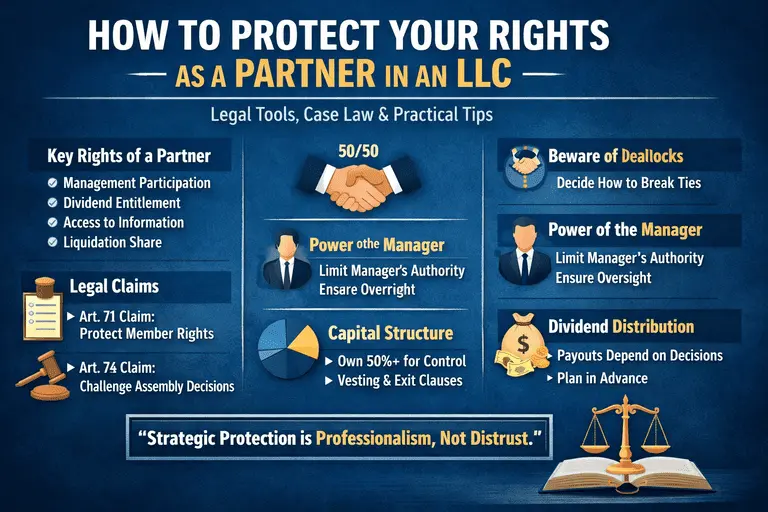
Legal instruments, court practice, and practical advice
In preparing this article, I have made every effort to keep legal jargon to a minimum, so that you – the reader, can follow it in plain, accessible language.
Registering a limited liability company (LLC / OOD) in Bulgaria is a relatively straightforward process: a company agreement, notarised signatures, and registration in the Commercial Register. The hard part comes after.
Most disputes between shareholders in the LLC do not arise because someone is inherently malicious, but because clarity is lacking: who controls decisions, who profits, who bears risk, and how one exits the venture. It is precisely at the founding stage that decisions are made which will define the balance of power for years to come.
Protecting your Bulgarian LLC Shareholder Rights is not a question of distrust. It is a question of professionalism and strategic thinking. In this guide you will find not only practical advice, but also information about the legal instruments and the Bulgarian Supreme Court of Cassation (SCC) case law available to you if things go wrong.
The Legal Framework: What the Commercial Act Says
Before addressing specific situations, it is important to understand the legal foundation of Bulgarian LLC Shareholder Rights protection. The Bulgarian Commercial Act (CA) provides several key instruments for safeguarding the membership rights of a Bulgarian Limited Liability Company shareholder.
Core Shareholder Rights – Art. 123 CA
Under Art. 123 Commercial Act, every shareholder holds four fundamental Bulgarian LLC Shareholder Rights: the right to participate in management, the right to a dividend, the right to be informed and to inspect the company’s books, and the right to a liquidation share. These rights are non-derogable – clauses in the company agreement that strip or materially limit them are void.
The Claim under Art. 71 CA – General Protection
Art. 71 CA gives every shareholder a universal claim against the company when its organs violate Bulgarian LLC Shareholder Rights. The company itself is the defendant. The claim may be declaratory (recognition of the right), constitutive (change of a legal position), or an action for performance. Crucially, legal interest is presumed – it is sufficient to prove that you are a shareholder.
⚖️ Bulgarian Supreme Court of Cassation: Under Interpretive Decision No. 1/2002 of the General Assembly of the Commercial Division of the SCC, it is firmly established that for the admissibility of a claim under Art. 71 CA it is sufficient for the claimant to establish their status as a shareholder. The cumulative joinder of claims under Art. 71 and Art. 74 CA in a single set of proceedings is also permissible.
The Claim under Art. 74 CA – Challenging General Meeting Resolutions
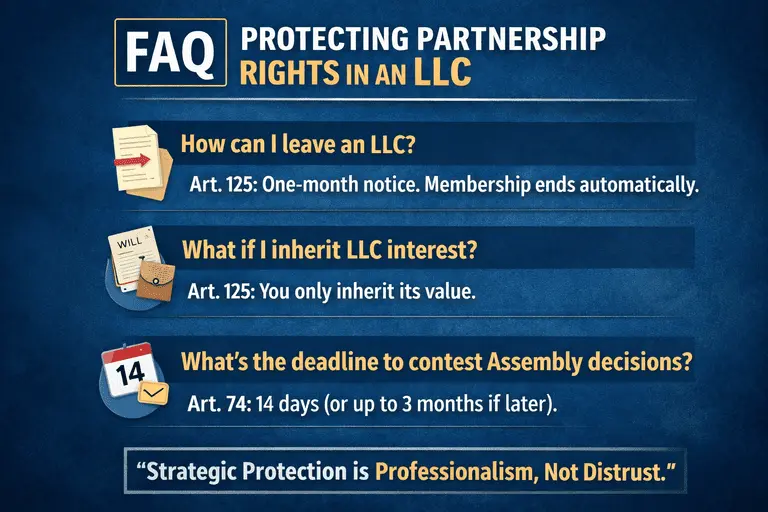
When the General Meeting passes a resolution that contradicts the law or the company agreement, a shareholder may challenge it in court within 14 days of the meeting (if present or duly notified), or within 14 days of learning of it, but no later than 3 months from the date of the meeting. The condition is that you hold shareholder status on the date of the meeting – if you have already resigned or been expelled, your right to challenge resolutions adopted after that point lapses.
Want to safeguard your business and legal rights with confidence?
At B&K Law Firm, our experienced team combines deep local expertise with a personalized approach to help you navigate complex corporate, commercial, and dispute-resolution issues. Whether you’re facing partner disputes, need contract review, or want strategic legal guidance tailored to your goals, we’re here to support you every step of the way.
Contact us today to schedule a consultation and take the next step toward secure, results-driven legal solutions.
1. Control Starts with the Capital Structure
Your percentage shareholding is not merely a symbolic figure. It determines your weight in the Bulgarian LLC General Meeting and your influence over the company’s strategic decisions.
If you hold 50% or more, you have direct control over decisions taken by simple majority. If you hold 49% or less, you are effectively dependent on the will of the majority – unless the company agreement provides specific protective mechanisms. Decisions that warrant particular attention include: changes to the company’s scope of activity, increases or reductions of share capital, admission of a new member, disposal of significant assets, taking on loans, and removal of the manager.
The practical solution is to require a qualified majority – for example two-thirds or three-quarters of the capital, or even unanimity – for such key decisions. This prevents the majority from imposing a strategic move that is detrimental to the other members.
⚖️ Bulgarian Supreme Court of Cassation: In an Bulgarian LLC composed of two shareholders with equal shares, SCC case law holds that one shareholder’s vote is sufficient to pass a resolution to expel the other, where the statutory grounds under Art. 126 CA are met (such as failure to perform obligations, conduct harmful to the company, or non-compliance with General Meeting resolutions). A 50/50 structure carries inherent risks, making the question of how deadlocked decisions are resolved critically important.
2. The Manager – The Real Centre of Power
In many Bulgarian Limited Liability Companies, the real power lies not with the shareholders but with the manager (Director). The manager represents the company externally and may independently enter into contracts and assume obligations. If you are not the manager, you must actively protect your access to information and meaningful control.
Both the company agreement and the management contract should address: the manager’s obligation to provide regular financial reports to shareholders, the right to access accounting documents at any time, restrictions on unilateral transactions above a defined value, and a prohibition on taking loans without a General Meeting resolution. Without these provisions, one person bears the risk of decisions made by another.
⚖️ Bulgarian Supreme Court of Cassation: A shareholder’s right to information is also judicially enforceable. Case law recognises a legitimate legal interest under Art. 71 CA even for a former shareholder who sought court access to company books before resigning, in order to verify the calculation of their exit share – SCC Decisions No. 128/2009, No. 204/2012, No. 174/2018, and Order No. 41/2015, all of the SCC.
3. The Dividend Is Not Guaranteed
Many shareholders assume that if the company is profitable, they will automatically receive a dividend. This is a misconception. Profit distribution in Bulgarian LLC is not automatic – it requires a resolution of the General Meeting. The majority can decide to reinvest profits for years without distributing any dividend.
If you are counting on dividends as income, the company agreement should provide for a minimum percentage of profit that is mandatorily distributed, clear criteria for when reinvestment is appropriate, and rules for the formation of reserves. Otherwise you may find yourself a member of a profitable company with no actual cash flow coming your way.
4. Shares Dilution – The Invisible Threat
One of the most common mechanisms for weakening a minority shareholder is a capital increase. If the General Meeting resolves to increase the share capital and you do not participate proportionally – either because you lack the financial means or because the resolution was passed without adequate notice – your stake diminishes. This can be repeated systematically until your influence becomes negligible.
Protection means having a pre-agreed right of pre-emption when new shares are issued, reasonable time limits for exercising that right, and a requirement for a qualified majority for any capital increase. Without these safeguards, you may gradually lose the influence you had when you joined the company.
5. Exiting the Company – The Most Overlooked Question
The most important question is not “How do we begin?” but “How do we end?”. The exit from the partnership must be considered at the founding stage, when all parties are on good terms and thinking rationally.
The key questions are: do you have the right to freely sell your shares to a third party – and the answer, by default, is NO; do the other shareholders hold a right of first refusal, if provided for in the company agreement; is there a pre-agreed valuation formula for the shares on buyout (for example an interim balance sheet or an independent expert valuation); and is there a mechanism for a forced buyout in the event of an irresolvable conflict?
Best practice is to include mechanisms such as a Right of First Refusal, Tag-along rights (the right to join a sale of the majority stake on equal terms), Drag-along clauses (where a majority sale requires the inclusion of minority members), and a Buy-sell mechanism in the event of a deadlock.
⚖️ Bulgarian Supreme Court of Cassation: Under SCC Decision No. 46 of 22 April 2010 (case No. 500/2009), the expiry of the notice period upon resignation under Art. 125 CA has an automatic terminating effect on the membership relationship. After that date, the former shareholder loses the right to challenge General Meeting resolutions under Art. 74 CA – even where they consider those resolutions to have financial consequences for them.
6. Expulsion of a Shareholder – How It Works in Practice
Expulsion is the most severe sanction available in an LLC. Under Art. 126 CA, a shareholder may be expelled for failure to perform their obligations – including obligations to contribute capital, to provide assistance, to comply with General Meeting resolutions, or where they act against the company’s interests. The expelled member loses their membership, but retains the right to the monetary equivalent of their shareholding.
⚖️ Bulgarian Supreme Court of Cassation: Interpretive Decision No. 1/2020 of the General Assembly of the Commercial Division of the SCC clarifies that expulsion is permissible for acts carried out by a shareholder in their capacity as manager, where those acts fall within the grounds listed in Art. 126(3)(1)–3 CA. Separately, an expelled shareholder retains procedural standing to challenge General Meeting resolutions passed at the same meeting on subsequent agenda items, where those resolutions are conditioned on the expulsion decision itself.
In practice: if you suspect that the majority is preparing your unlawful expulsion, act immediately. Seek legal advice before the resolution is entered in the Commercial Register.
7. The 50/50 Deadlock When the Company Grinds to a Halt
In a 50/50 structure, the risk of a complete management impasse is real and serious. If two equal shareholders hold irreconcilable positions on a strategic matter, the General Meeting cannot pass a resolution, and the company may remain paralysed for months or years.
Available solutions include: a mandatory mediation clause (at least 30 days of good-faith negotiation before litigation), arbitration (faster and more confidential than court proceedings), and a Shoot-out mechanism – one party names a price for the other’s shares, and that party chooses whether to buy or sell at that same price. The last option is particularly effective because it compels both sides to propose a fair valuation.
8. Non-Compete Clauses and Share Vesting
If a shareholder is simultaneously developing a competing business, they are undermining the common venture – using the company’s resources, clients, and know-how to build their own competitor. Without an explicit non-compete clause in the company agreement, you have virtually no protection.
The clause should define precisely what constitutes competitive activity (subject matter, market, clientele), the geographic scope, the duration after departure, and the consequences of a breach – for example, an obligation to pay damages or a forced buyout of shares.
A separate issue is share vesting – a mechanism under which a member who contributes labour, know-how, or contacts rather than capital acquires their full share rights progressively over time. If they leave or are expelled early, they receive only the portion earned to date. The practice of Western European and American start-ups shows that a four-year vesting schedule with a one-year cliff (the first quarter vests only after the first year) is a workable standard that can also be implemented in Bulgaria. Bulgarian law does not expressly regulate vesting; it is structured through conditional transfers, buyback rights, or suspensive conditions, and must be carefully drafted to avoid conflicts with the Commercial Act.
9. Death of a Shareholder – What Is Inherited
This question is rarely considered at the founding stage, yet it is practically significant. Upon the death of a shareholder, the economic rights – the value of the shares – pass to their estate. Membership itself, however, does not automatically transfer to the heirs.
⚖️ Bulgarian Supreme Court of Cassation: Under SCC Decision No. 161 of 11 January 2011 (First Commercial Division), upon the death of a shareholder, heirs acquire the economic rights (the shareholding expressed as a monetary value), but not membership itself. The heir must undergo the procedure for admission as a new member set out in the company agreement. If they are not admitted, they receive the monetary equivalent of the share.
In practice, the company agreement should expressly address: whether membership is automatically offered to heirs, the majority required to vote on their admission, and the timeframe and method of payment of the share if they are not admitted.
10. Personal Liability – Limited, But Not Zero
Bulgarian Limited Liability Company in principle provides limited liability for its members – they are liable only up to the amount of their contribution. In practice, however, banks, leasing companies, and sometimes suppliers require personal guarantees from shareholders for more significant financial commitments.
Before signing a personal guarantee, verify: whether it is a joint and several guarantee (each guarantor is liable for the entire debt), what the maximum extent of your personal exposure is, and – critically – how you are released from the guarantee when you exit the company. Otherwise you may cease to be a member yet remain personally bound by the company’s debts for years.
11. The Company Agreement and the Shareholders’ Agreement
The company agreement is a public document, registered in the Commercial Register and accessible to any third party. It governs the formal rules of the company. For that reason, detailed arrangements between shareholders – those affecting their internal relationship – are typically placed in a separate, non-public shareholders’ agreement.
This document can include: detailed exit mechanisms, a dividend policy, dispute resolution procedures, confidentiality obligations, a non-solicitation clause (prohibition on poaching employees), and any arrangements the parties wish to keep private. It is the instrument that provides the real predictability and stability in the relationship between members.
12. Document Your Expectations – Before There Is a Problem
Many disputes arise not because someone has breached an agreement, but because the parties held different understandings from the very outset. Discuss openly and record the answers to the following questions: What is the vision for the company’s development, and over what time horizon? How much risk are we willing to take, conservative growth or aggressive scaling? Are we counting on dividends, or on selling the company in a few years? What happens if someone wants to exit after two years?
If expectations differ fundamentally, conflict is only a matter of time. The conversation before the agreement is signed is free. Litigation is not.
Conclusion
Protecting your Bulgarian LLC Shareholder Rights rests on two pillars: well-structured documents from the very beginning, and an understanding of the legal instruments available to you if things do not go to plan.
The Commercial Act provides real remedies – claims under Art. 71 and Art. 74 CA, the right to information, and protection against unlawful expulsion. The SCC’s case law, accumulated over decades, clarifies which rights are non-derogable, under what conditions a member may be expelled, and how exit from the company operates.
But the best Bulgarian LLC Shareholder Rights protection is preventive. Investment in a well-structured company agreement and a clear shareholders’ agreement at the outset can prevent years of disputes and significant financial losses down the line. Incorporating an LLC is the easy part – the real test comes when the business starts to generate profit, incur losses, or attract outside interest. When the rules are clear from the beginning, conflicts are resolved rationally, not emotionally.
Frequently Asked Questions (FAQ)
What are my fundamental Bulgarian LLC Shareholder Rights?
Art. 123 CA guarantees four non-derogable rights: the right to participate in management, the right to a dividend, the right to information (to inspect the company’s books), and the right to a liquidation share. Clauses in the company agreement that strip or materially limit these rights are void.
How can I protect my rights as a minority shareholder in Bulgarian LLC?
The key is to build in protective mechanisms at the founding stage: a qualified majority requirement for strategic decisions, pre-emption rights on new shares (anti-dilution protection), tag-along rights, and a clear valuation formula on exit. If a breach has already occurred, you have the claim under Art. 71 or Art. 74 CA against the company.
Can I challenge a General Meeting resolution as a shareholder?
Yes. Under Art. 74 CA, any General Meeting resolution that contradicts the law or the company agreement may be challenged in court within 14 days of the meeting or of learning of it, but no later than 3 months from the date of the meeting. The condition is that you held shareholder status on the date of the meeting.
What is the difference between the company agreement and a shareholders’ agreement?
The company agreement is public – it is filed with the Commercial Register and accessible to anyone. It governs the formal structure of the company. The shareholders’ agreement is a private document between the members, covering the details: dividend policy, exit mechanisms, non-compete obligations, and dispute resolution procedures. It provides the flexibility that real partnerships require.
Can the majority decide not to distribute a dividend?
Yes. Profit distribution is a matter for the General Meeting, and the majority may resolve to reinvest it. If you are relying on dividends as income, you should include in the company agreement a minimum percentage of profit that must be distributed whenever a profit is achieved.
How does expulsion under Art. 126 CA work?
Expulsion is available where a member fails to make their capital contribution, fails to comply with General Meeting resolutions, acts against the company’s interests, or fails to provide required assistance. The expelled member loses their membership but retains the right to the monetary value of their shareholding. The resolution may be challenged under Art. 74 CA.
What is a deadlock clause and why do I need one?
A deadlock clause establishes a mechanism for reaching a decision when two equal shareholders (50/50) cannot agree. Without one, the company may remain blocked indefinitely. Practical solutions include mediation, arbitration, and a shoot-out mechanism, under which one party names a price and the other chooses whether to buy or sell at that price.
What happens to shares if a shareholder dies?
The economic rights – the value of the shares – pass to your estate. Membership itself does not transfer automatically. Shareholder’s heirs must undergo the admission procedure for a new member. If they are not admitted, they receive the monetary equivalent of the shareholding, as confirmed by SCC Decision No. 161/2011.
Bulgarian LLC Shareholder Rights Key Data Table
Table 1 – Core Bulgarian LLC Shareholder Rights under Art. 123 CA
| # | Right | Legal Basis | Can It Be Waived? | How to Enforce |
|---|---|---|---|---|
| 1 | Participate in management (vote at General Meeting) | Art. 123(1) CA | No – any waiver clause is void | Claim under Art. 71 CA |
| 2 | Receive a dividend | Art. 123(2) CA | No – but distribution requires a GM resolution | Claim under Art. 71 CA + Art. 181 CA |
| 3 | Access to information & company books | Art. 123(3) CA | No – even former shareholders may enforce it | Claim under Art. 71 CA |
| 4 | Liquidation share upon dissolution | Art. 123(4) CA | No – any waiver clause is void | Liquidation proceedings |
Table 2 – Legal Claims Available to Shareholders
| Situation | Legal Instrument | Deadline | Who Is Sued | SCC Authority |
|---|---|---|---|---|
| Manager violates membership rights | Art. 71 CA | No limitation period | The company | Int. Decision No. 1/2002, OSCD SCC |
| Unlawful GM resolution | Art. 74 CA | 14 days from GM / learning of it; max 3 months | The company | Int. Decision No. 1/2002, OSCD SCC |
| Unlawful expulsion | Art. 74 + Art. 71 CA | 14 days from GM; max 3 months | The company | Int. Decision No. 1/2020, OSCD SCC |
| Dividend refused / withheld | Art. 181 CA + Art. 71 CA | General limitation rules | The company | — |
| Access to books denied | Art. 71 CA | No limitation period | The company | SCC Dec. No. 128/2009; No. 204/2012; No. 174/2018 |
| Exit / resignation (Art. 125 CA) | Art. 125 CA | 3-month notice | N/A – unilateral act | SCC Dec. No. 46/2010 |
| Death of shareholder – heir not admitted | Art. 125 CA | Per company agreement | The company | SCC Dec. No. 161/2011, I Comm. Div. |
Table 3 – Key Supreme Court of Cassation Decisions
| Decision | Issue Settled | Practical Takeaway |
|---|---|---|
| Int. Decision No. 1/2002 OSCD SCC | Admissibility & scope of Art. 71 CA claims; joinder with Art. 74 CA | Shareholder status alone establishes legal interest; both claims can be brought together |
| Int. Decision No. 1/2020 OSCD SCC | Expulsion for acts as manager; procedural standing of expelled shareholder | A shareholder can be expelled for misconduct as manager; expelled members can still challenge conditioned GM resolutions from the same meeting |
| Decision No. 46/22.04.2010 Case No. 500/2009, SCC | Effect of resignation notice under Art. 125 CA | Membership terminates automatically when the notice period expires – Art. 74 CA rights lapse from that date |
| Decision No. 161/11.01.2011 I Comm. Div., SCC | Inheritance of shares upon shareholder’s death | Heirs inherit economic value only – not membership; admission procedure must be followed or the monetary equivalent is paid out |
| Decisions No. 128/2009, 204/2012, 174/2018 SCC; Order No. 41/2015 | Right to information – former shareholders | Even a departing shareholder retains the right to inspect books to verify the calculation of their exit share |
Table 4 – Protective Mechanisms Checklist for the Company Agreement
| Risk Area | Mechanism to Include | Risk if Absent | Priority |
|---|---|---|---|
| Loss of control | Qualified majority (⅔ or ¾) for key decisions | Majority can impose any strategic change | Critical |
| Share dilution | Pre-emption right on new share issuance + anti-dilution clause | Stake reduced without consent | Critical |
| Blocked exit | Right of First Refusal + valuation formula (interim balance / expert) | Shares unsellable at fair value | Critical |
| 50/50 deadlock | Mediation clause → Arbitration → Shoot-out mechanism | Company paralysed indefinitely | Critical |
| No dividend | Minimum mandatory distribution % in company agreement | Profit reinvested indefinitely against member’s interest | High |
| Opaque management | Regular financial reporting obligation; access to accounting books | Unable to monitor manager’s actions | High |
| Competing activity | Non-compete clause (scope + geography + duration + remedy) | Member builds rival business using shared resources | High |
| New member admitted | Qualified majority + admission criteria in agreement | Unknown party enters without consent | High |
| Labour-only contribution | Vesting schedule (4-year + 1-year cliff) | Member exits early but keeps full share | High |
| Personal guarantees | Cap on guarantee + release mechanism on exit | Bound by company debts after leaving | High |
| Tag-along / Drag-along | Tag-along rights for minority; drag-along for exit efficiency | Minority left behind or majority blocked | Standard |
| Death of shareholder | Heir admission procedure + payout terms if not admitted | Uncertainty and disputes with estate | Standard |
All legal references are to the Bulgarian Commercial Act (Търговски закон). SCC = Supreme Court of Cassation of Bulgaria. This table is for informational purposes only and does not constitute legal advice.
About the Author: Anton Popov is a corporate lawyer at B&K Law Firm with more than 12 years experience advising international founders on Bulgarian commercial law. He has guided 200+ companies through entity formation and regularly consults on LLC, VCC and JSC structures for Ai, tech and fintech ventures. Attorney Popov is recognized for his strategic negotiation skills in ADR and litigation expertise before Bulgarian courts.










Leave a Reply
You must be logged in to post a comment.