Last Updated: January 31, 2026
European Economic Interest Grouping in Bulgaria: Legal Framework, Registration, Liability and Tax Treatment

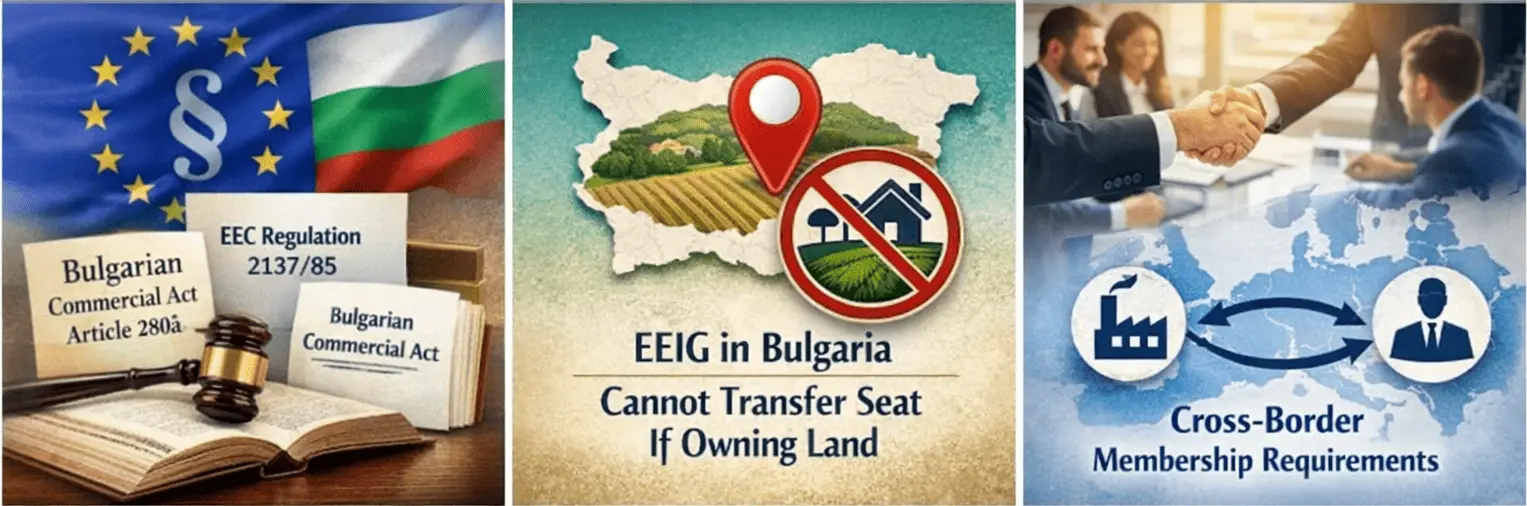
In Bulgaria, the EEIG is expressly recognised as a legal entity under Article 280a of the Bulgarian Commercial Act and is registered in the Bulgarian Commercial Register kept by the Registry Agency. The EEIG combines features of a civil partnership (common purpose) and a general partnership (strong personal element and unlimited joint liability of members).
A European Economic Interest Grouping (EEIG) is an EU legal form designed to facilitate and develop the economic activities of its members from different Member States, helping them improve their results rather than generate profit for the grouping itself. Its activity must be directly related and ancillary to the economic activities of its members and may only support, but not replace, their business.
EU and Bulgarian Legal Framework for EEIGs
The legal regime of EEIGs rests on two main pillars:
- Council Regulation (EEC) No 2137/85 on the European Economic Interest Grouping (EEIG).
- Bulgarian Commercial Act PDF version (Targovski zakon) – Chapter XVIII, Section III, in particular Articles 280a–280zh (EEIG provisions referring to general partnership rules and insolvency rules).
Article 280a(1) of the Commercial Act provides that an European Economic Interest Grouping is a legal entity entered in the Commercial Register. Article 280a(3) states that members of an EEIG registered in Bulgaria are liable under the rules applicable to partners in a Bulgarian general partnership, i.e. jointly, severally, unlimitedly and subsidiarily.
Regulation 2137/85 leaves key matters to national law, such as tax treatment, competition, intellectual property, labour and social rights, the legal status of participants, grounds for dissolution and opening of insolvency proceedings. In Bulgaria, registration and disclosure of European Economic Interest Grouping acts (formation, changes, liquidation, transfer of seat) take place in the Commercial Register and the register of non‑profit legal entities under the Registration Act.
Seat and registered address of the EEIG and Bulgarian Specific Restriction
The applicable law to an EEIG in Bulgaria is determined by its seat; the law of the Member State where the European Economic Interest Grouping has its official seat applies. The seat must be located in the EU and coincide either with the EEIG’s central administration or with the central administration or principal place of business of one of its members, provided the grouping carries out actual activities at that place.
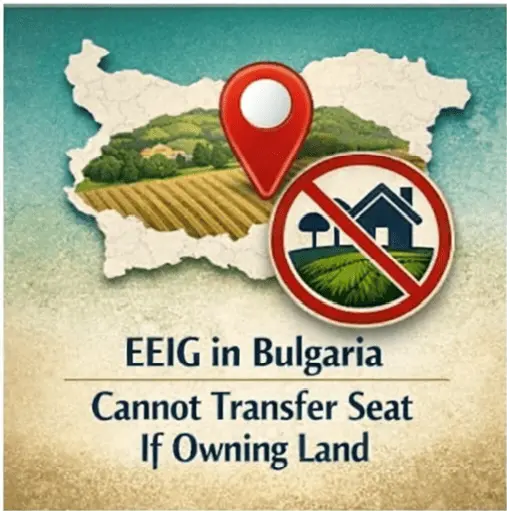
Regulation 2137/85 allows transfer of the European Economic Interest Grouping’s seat within the EU, subject to publication of a transfer plan and protection of creditors. Bulgarian law introduces a specific restriction: an EEIG with its seat in Bulgaria may not transfer its seat to another Member State if it owns land in the Republic of Bulgaria (Article 280a(4) of the Commercial Act).
Who Can Be a Member of an EEIG in Bulgaria?
Under Article 4 of Regulation 2137/85, the following may participate in an European Economic Interest Grouping:
- Companies or firms within the meaning of Article 54 TFEU (former Article 48 EEC) and other legal bodies governed by public or private law, having their registered office and central administration in the EU.
- Natural persons carrying out any industrial, commercial, craft or agricultural activity, exercising a liberal profession or providing other services within the EU.
There must always be a cross‑border element. At least one of the following combinations is required:
- At least two companies or other legal bodies whose central administration is in different Member States.
- At least two natural persons whose principal business activities are carried out in different Member States.
- One company or other legal body with its central administration in the EU and one natural person whose principal business activity is in another Member State.
Member States may, for reasons of public interest, exclude certain categories of natural or legal persons from becoming members and may limit the number of members in an European Economic Interest Grouping registered on their territory to 20. Bulgarian law does not introduce an explicit national 20‑member cap, so the limitation stems directly from the Regulation.
EEIG Activity and Mandatory Restrictions
Regulation 2137/85 lays down strict limits on the activities of an European Economic Interest Grouping to preserve its ancillary character:
- The EEIG’s objective is to facilitate or develop the economic activities of its members and to improve or increase the results of those activities; it must not aim to make profits for itself.
- Its activities must be related to the economic activities of its members and may only be ancillary to them – the grouping must not become essential to members’ operations.
The Regulation also imposes explicit prohibitions:
- The European Economic Interest Grouping may not directly or indirectly control or manage the activities of its members or other undertakings, especially their staff, finances or investments.
- It may not directly or indirectly hold shares or interests in a member undertaking, except where this is necessary to achieve the EEIG’s purpose and is for the account of its members.
- It may not employ more than 500 employees.
- It may not be used as a vehicle for granting loans or similar transactions to directors or related parties where such loans are restricted under applicable national law, nor for transfers of assets from a company to its director or related party contrary to national law.
- An European Economic Interest Grouping cannot be a member of another EEIG.
Formation and Registration of an European Economic Interest Grouping in Bulgaria
Two Cumulative Requirements
To validly form an EEIG, Regulation 2137/85 requires two cumulative elements:
- A contract (Articles of Association) for the formation of the European Economic Interest Grouping.
- Registration of the EEIG in the register designated by the Member State of its seat (in Bulgaria – the Commercial Register and the NPLE register).
In Bulgaria, formation is completed upon entry in the Commercial Register and the register of non‑profit entities; publication of acts (formation, amendments, dissolution, seat transfer) in the Official Journal of the EU is based on the data from the national register.
Minimum Content of Formation Contract
Article 5 of Regulation 2137/85 sets minimum content requirements for the formation contract:
- Name of the grouping, followed or preceded by the abbreviation “EEIG”.
- Seat of the grouping.
- Object (scope of activities).
- Identification of each member (name/firma, legal form, registered office or domicile, registration number and register, if any).
- Duration of the grouping, unless it is formed for an indefinite period.
In business correspondence, the EEIG must always indicate its name including the abbreviation “EEIG” and its seat.
The following data must be filed and published in the Commercial Register / NPLE register:
- All amendments to the formation contract and changes in membership.
- Opening and closure of branches or establishments.
- Court decisions declaring nullity of the European Economic Interest Grouping.
- Appointment and removal of managers and liquidators, including whether they act individually or jointly and the conditions of their mandates.
- Transfers of membership interests.
- Decisions on voluntary dissolution and court orders for compulsory dissolution.
- Completion of liquidation.
- Plans for transfer of the registered seat.
- Any clause exempting a newly admitted member from pre‑existing liabilities.
Governance: Members and Manager(s)
Under the Regulation, an European Economic Interest Grouping has two mandatory internal bodies:
- The members acting collectively (equivalent to a general meeting / association of partners).
- One or more managers (the executive body and legal representative).
The members, acting as a body, may take all decisions necessary to achieve the EEIG’s objects, but external representation vis‑à‑vis third parties lies with the manager(s).
Manager’s Powers and Representation
As a rule, the European Economic Interest Grouping is represented vis‑à‑vis third parties by its manager; where there is more than one manager, each of them may represent the EEIG individually, unless the formation contract requires joint action by two or more managers. A clause on joint representation is enforceable against third parties only if duly disclosed (published) in the relevant register, and commercial correspondence must indicate that managers are required to act jointly.
Restrictions of the manager’s representative authority arising from the formation contract or members’ resolutions are not enforceable against third parties, even where published, except for an agreed joint‑signature requirement. Acts of a manager outside the stated objects of the European Economic Interest Grouping remain binding on the EEIG unless it proves that the third party acted in bad faith.
A manager must be a natural person designated in the formation contract or appointed by unanimous decision of the members; national law may allow a legal entity to act as manager through authorised individuals. In Bulgaria, general rules of the Commercial Act apply to disqualification grounds (for example, Articles 57 and 234(2) CA on persons banned from managing companies).
Membership, Voting and Member Rights
By default, each member of an European Economic Interest Grouping has one vote. The formation contract may grant a member more than one vote, but no member may hold a majority of the votes.
Unanimity of all members is required for a number of key decisions, including:
- Change of the European Economic Interest Grouping’s objects.
- Change in the number of votes held by each member.
- Change in decision‑making rules.
- Extension of the EEIG’s term where it was formed for a fixed period.
- Change in members’ contributions to the European Economic Interest Grouping’s financing.
- Any change to a member’s obligations, unless the formation contract provides otherwise.
- Amendments to the formation contract, unless it stipulates different rules.
The formation contract may lay down quorum requirements and majority thresholds for other decisions; if it does not, unanimity applies by default. Members have a right to information about the EEIG’s activities, provided by the managers, and may inspect the European Economic Interest Grouping’s books and documentation.
Profit Allocation and Tax Treatment of EEIGs
The general principle under Regulation 2137/85 is that the results of an EEIG’s activity are taxed only at member level, not at the level of the grouping itself. Profit (or loss) is treated as profit (or loss) of the members and is allocated between them according to the formation contract; where the contract is silent, the allocation is equal.
Members are obliged to make cash contributions where the European Economic Interest Grouping’s expenses exceed its income, in the proportions set out in the contract or equally in the absence of such a clause. In Bulgaria, this transparent treatment means that corporate income tax or personal income tax is normally assessed on the members, not on the European Economic Interest Grouping as a separate taxpayer, while VAT and social security obligations may still arise where the EEIG itself performs taxable supplies or employs staff.
Transfer, Security and Termination of Membership
A member may transfer its participation in the European Economic Interest Grouping, in whole or in part, to another member or to a third party only with the unanimous consent of all other members. Membership may be pledged or otherwise used as security only with the unanimous consent of the other members, and such security does not, by itself, entitle the secured creditor to become a member.
Membership may be terminated:
- In accordance with the conditions laid down in the formation contract.
- By unanimous consent of the other members where no contractual rule exists.
- For “good cause”, a concept left to be interpreted under national law and circumstances (for example, taking up positions or activities incompatible with the EEI Grouping’s purpose).
The manager must notify the other members of a member’s intention to withdraw, and the withdrawal must be disclosed in the Commercial Register. The EEI Grouping continues with the remaining members under the contract or, failing any provision, under a unanimous decision of the remaining members.
A member may be excluded if, by its conduct, it harms or seriously endangers the EEI Grouping’s activities or grossly breaches its obligations. As with a Bulgarian general partnership, exclusion is initiated by the members but ordered by a court decision. On death of a natural person member, another person may be admitted in their place only if the contract so provides or the remaining members unanimously agree.
A departing or excluded member remains liable for obligations that arose before their departure. The value of that member’s rights and obligations towards the European Economic Interest Grouping in Bulgaria is determined at the date of departure or exclusion; pre‑determination of this value is not allowed.
Liability of EEI Grouping Members Under Bulgarian Law
Members of an EEI Grouping are jointly and severally and unlimitedly liable for the EEI Grouping’s obligations, with the exact consequences governed by national law. Under Bulgarian law, the rules on partners in a general partnership apply by reference (Article 280a(3) CA), which means:
- Liability is joint and several and unlimited (partners are liable with all their assets).
- Liability is subsidiary – enforcement is directed first against the EEI Grouping and only then against partners’ personal assets, in line with Article 88 CA.
Article 96 CA applies by analogy: a personal creditor of a member who cannot obtain satisfaction from the member’s personal assets for six months may seize that member’s liquidation share and request dissolution of the partnership (and by extension, of the EEI Grouping).
Liability of members is generally ex tunc: a new member is liable for obligations incurred before their admission, unless the formation contract or a unanimous decision of the members (duly registered) releases them from prior liabilities. For claims against a former member relating to obligations of the EEIG incurred before their departure, Regulation 2137/85 provides a maximum five‑year limitation period running from publication of the member’s departure; longer national periods must be reduced to five years.
Nullity, Dissolution and Insolvency of an EEIG
Nullity of an European Economic Interest Grouping in Bulgaria can be declared only by a court decision under the law of the Member State of its seat. In Bulgaria, Article 280a(3) CA refers to Article 70 CA on grounds for nullity of companies, excluding those applicable only to capital companies; nullity has effect towards third parties from the date of registration and does not affect obligations entered into before that date.
Dissolution of an European Economic Iinterest Grouping may occur:
- By unanimous resolution of the members, unless the contract provides otherwise.
- On expiry of the European Economic Iinterest Grouping’s term.
- If the number of members falls below the minimum required by Regulation 2137/85.
- Upon achievement or impossibility of achieving the EEI Grouping’s purpose.
- For other important reasons.
If the members do not resolve to dissolve the EEI Grouping within three months after an event giving rise to dissolution, any member may apply to the court to order dissolution. In Bulgaria, the competent court is the district court at the EEIG’s seat (Article 2806 CA).
Where the European Economic Iinterest Grouping pursues unlawful purposes, carries out prohibited activities under Article 3 of the Regulation, has an improperly determined seat or has fewer members than required, any interested person or competent authority may seek dissolution; the court may grant a period for remedying the defects.
Article 2806 CA expressly allows dissolution of an European Economic Interest Grouping in Bulgaria at the request of the public prosecutor if its activities threaten public order in Bulgaria. After dissolution, the European Economic Iinterest Grouping is liquidated under the rules of Chapter XVII CA on liquidation of companies, and Regulation 2137/85 requires that publication in the Official Journal of the EU follows national publication so that dissolution is enforceable EU‑wide.
Insolvency
Article 36 of Regulation 2137/85 refers to national law with respect to insolvency and suspension of payments. Article 2806 CA provides that the insolvency regime in Part IV of the Commercial Act applies to EEI Groupings, while Article 610 CA (insolvency of partners in general and limited partnerships) does not apply to European Economic Interest Grouping members. If a member of an European Economic Iinterest Grouping is declared insolvent, their participation in the grouping is terminated by the liquidator or insolvency administrator.
EEIG in Bulgaria – Key Practical Takeaways
- An European Economic Iinterest Grouping is an EU‑based, flexible vehicle for cross‑border cooperation that in Bulgaria enjoys legal personality and is registered in the Commercial Register.
- It is suitable where businesses or professionals in different Member States want to collaborate, share costs or infrastructure and improve results without setting up a full‑fledged company.
- Bulgarian law adds specific features, notably the reference to general partnership liability rules and the restriction on transferring the seat where the European Economic Iinterest Grouping owns Bulgarian land.
Need Advice on Setting Up an Economic Interest Grouping in Bulgaria?

If you are considering forming a European Economic Interest Grouping (EEIG) in Bulgaria, choosing the right legal team is critical for getting the structure, cross‑border element and liability aspects right from day one. B&K Law Firm (Belcheva & Karadjova Law Firm) advises investors, entrepreneurs and international companies on Bulgarian and EU corporate, commercial and regulatory matters, including complex partnership and cooperation structures.
Our lawyers combine deep knowledge of Bulgarian company and commercial law with practical experience in cross‑border projects, enabling you to set up and operate your European Economic Interest Grouping with confidence, full compliance and clear risk management. Whether you are coordinating activities across several EU jurisdictions, sharing infrastructure with partners or restructuring an existing collaboration, we can support you at every stage – from initial structuring and drafting of the European Economic Interest Grouping agreement to registration, ongoing governance and dispute resolution.
Contact B&K Law Firm today to discuss your project:
- Email: office@bglegalfirm.com
- Phone: +359 87 666 7487 / +359 88 897 3040
- Address: 28 Tsar Samuil St., Office 11, 4400 Pazardzhik, Bulgaria
Our central location in Pazardzhik, close to Sofia, Plovdiv and other key economic hubs, allows us to efficiently assist clients across the whole country as well as foreign businesses entering the Bulgarian and EU market.
About the Author: Anton Popov is a Bulgarian corporate and commercial lawyer with a strong focus on EU business structures, including European Economic Interest Groupings (EEIG), cross‑border partnerships and complex joint‑venture arrangements. He advises both local and international clients on company formation, corporate governance and regulatory compliance under Bulgarian and EU law, with particular experience in structuring collaborative projects between businesses from different Member States.
At B&K Law Firm he has more than 12 years experience advising international founders on Bulgarian commercial law. He has guided 200+ companies through entity formation and regularly consults on LLC, JSC, VCC structures for Ai, tech and fintech ventures. Attorney Popov is recognized for his strategic negotiation skills in ADR and litigation expertise before Bulgarian courts.