Bulgarian VCC (Variable Capital Company): Complete 2026 Guide to Newest Company Formation, Requirements, Costs, Compliance & Taxation
By Lawyer Anton Popov, B&K Law Firm | Last Updated: January 26, 2026
Bulgaria’s Variable Capital Company (VCC) represents the most significant corporate law innovation for startups since registration opened on December 15, 2024. This hybrid entity has quickly become the preferred structure for ventures navigating Bulgaria’s euro transition while seeking venture capital.
About the Author: Anton Popov is a corporate lawyer at B&K Law Firm with more than 12 years experience advising international founders on Bulgarian commercial law. He has guided 200+ companies through entity formation and regularly consults on VCC structures for Ai, tech and fintech ventures. Attorney Popov is recognized for his strategic negotiation skills in ADR and litigation expertise before Bulgarian courts.
What is a Bulgarian VCC?
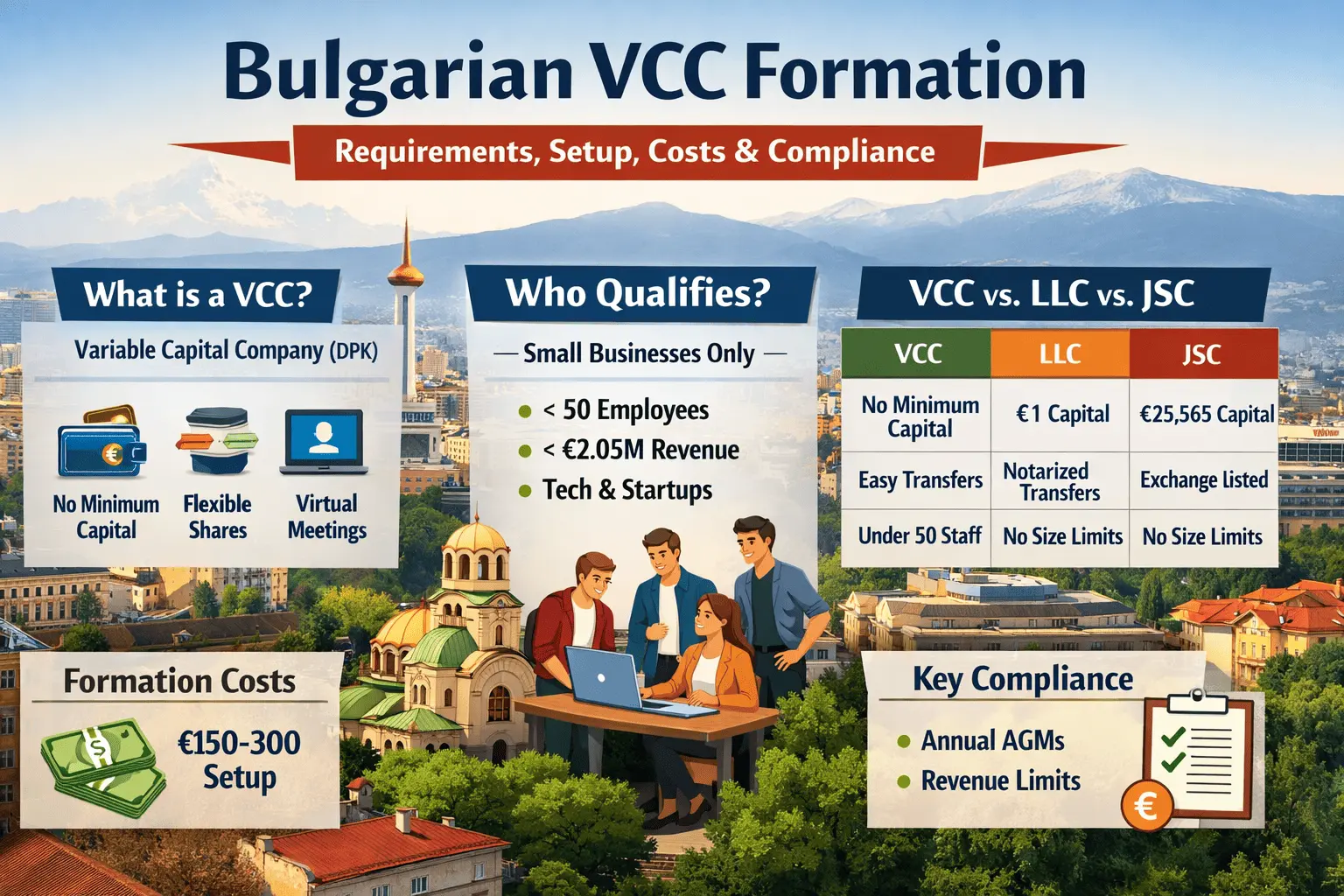
The Bulgarian Variable Capital Company –Druzhestvo s promenliv kapital (DPK) – emerged from August 2023 Commercial Act amendments as a purpose-built vehicle for high-growth enterprises. Unlike traditional entities requiring fixed capital deposits, this structure eliminates initial capital registration requirements and allows annual capital determination by shareholders.
Think of it as an Bulgarian LLC that speaks venture capital’s language. The structure blends limited liability simplicity with joint stock company investor tools, flexible capital structure and enhancement of equity investments, offering simplified share transfers, multiple share classes, virtual general meetings, and no bank account requirement at registration.
Who Qualifies for VCC (Variable Capital Company) Formation in Bulgaria?
The structure of Variable Capital Company serves a deliberately narrow segment: companies qualifying as micro or small enterprises with fewer than 50 employees and annual turnover or assets not exceeding €2.05 million (approximately 4 million leva at Bulgaria’s pre-euro fixed rate).
VCC’s Critical Compliance Point
These thresholds aren’t suggestions – they’re hard ceilings with serious consequences. Variable Capital Companies exceeding limits must transform into an LLC or JSC by year-end of the year following acknowledgment, with failure potentially triggering mandatory liquidation.
Ideal Candidates For VCC Formation
- Pre-Series A tech startups raising €50K-€500K
- Fintech companies testing products with under 30 employees
- AI/ML ventures requiring flexible equity structures
- E-commerce businesses with variable contractor arrangements
- Creative agencies scaling from 5 to 40 team members
Poor Fits
- Mature businesses approaching 40+ employees (conversion risk)
- Capital-intensive manufacturing (exceeds asset thresholds)
- Regulated financial institutions (require JSC structure)
- Any company projecting 50+ employees within 24 months
VCC vs LLC vs JSC: Strategic Comparison
| Feature | VCC | LLC (OOD) | JSC (AD) |
|---|---|---|---|
| Min. Capital | None (no deposit) | €1 registered | €25,565 registered |
| Share Transfer | Simple written agreement | Notarized deed required | Stock exchange or agreement |
| Min. Share Value | €0.01 per share | €0.01 quota | €0.51 share |
| Share Classes | Multiple permitted | Single class only | Multiple permitted |
| Virtual AGMs | Explicitly allowed | Not permitted | Public JSCs only |
| Size Limits | <50 staff, <€2.05M | None | None |
| Setup Time | 3-7 days | 5-10 days | 10-20 days |
| Setup Cost | €150-300 DIY | €200-400 | €1,500-3,000 |
Choose VCC if: You’re raising from 3+ investors, need employee stock options, want flexible capital adjustments, or require virtual meeting capabilities.
Stick with LLC if: You’re a solo founder with no near-term investment plans, your model will clearly exceed thresholds within 18 months, or you prefer maximum legal precedent.
Core VCC Features
Variable Capital Mechanics
Each year’s Annual General Meeting (held by June 30) determines capital based on actual business needs, creating three advantages:
- No Upfront Deposit: Skip the bank statement requirement that adds 5-20 days to LLC formations
- Frictionless Investment Rounds: New investors join without capital increase filings
- Organic Downsizing: Departing founders or buybacks auto-adjust at next AGM
Share Structure
Shares can belong to different classes with minimum nominal value of €0.01 (1 euro cent) – substantially lower than €0.51 minimums for JSCs. This enables:
- Founder shares with enhanced voting rights (1 share = 10 votes)
- Investor preferred shares with liquidation preferences
- Employee common stock with vesting schedules
- Advisor shares with restricted transfer rights
Critical: Share classes must be defined in Articles of Association at formation.
Simplified Transfers
Perhaps the most celebrated feature: transfers complete through written agreements without notary verification, provided Articles permit it. This transforms investor onboarding from 2-3 week notary appointments to single-day executions.
Management Flexibility
Minimum requirement: one director (individual, resident or non-resident). Most investor-backed structures adopt boards immediately to accommodate investor seats. Virtual AGMs accommodate international founder teams – a major advantage over traditional LLCs.
VCC (Variable Capital Company) Formation Process & Timeline
Week 1: Preparation
- Reserve unique name ending “VCC” or “DPK” via registry portal
- Draft Articles of Association
- Assemble documents: Articles, application form, UBO declaration, manager consents, identification documents, declarations, registered address proof
Week 2: Registry Filing
- Submit electronically via Registry Agency portal (€28 fee) using qualified electronic signatures
- Processing time: 3 business days standard; 5-7 days for complex applications
- Paper filing available but slower and costier (€56)
Week 3: Post-Registration
- Open bank account (5-20 days for Bulgarian banks; 1-3 days for FinTech bank options)
- Register for VAT if projected turnover exceeds €51,130
- Establish accounting infrastructure
Total Timeline: 1-2 weeks from name check to operational status
VCC Formation Costs (2026)
DIY Minimum: €108-178
- Registry fee: €28
- Qualified electronic signature: €30-50
- Registered address: €300-500 annually
Standard Professional: €708-1,378
- Registry fee: €28
- Legal services: €300-600
- Translations (if a foreign entity is founder): €80-250
- Banking assistance: €200-300
- Initial accounting: €200-400
Investor-Ready Premium: €1,778-3,428
- Registry fee: €28
- Custom legal services: €800-1,500
- Shareholders’ agreement: €500-1,000
- Notarizations/apostilles: €150-300
- Banking + compliance: €200-400
Tax Treatment
Critical Point: VCCs receive zero special tax treatment. Obligations mirror LLCs and JSCs identically.
- Corporate Income Tax: 10% on profits (annual return due March 31)
- Dividends: 5% withholding tax (EU parent-subsidiary exemptions apply)
- VAT: Mandatory registration above €51,130 annual turnover
- Payroll: Approximately 18% employer social contributions plus ~13% employee contributions
Why This Matters: Choose VCC for structural flexibility, not tax optimization. The advantage lies in ESOP implementation—share grants avoid payroll taxes until liquidation events.
Compliance Calendar
Annual Obligations
- By June 30: Hold AGM, approve financial statements, determine capital
- By September 30: File annual financial statements with registry
- By June 30: Submit corporate tax return and payment
Quarterly & Monthly
- VAT returns (if registered): 14th of month following quarter
- Social security declarations: Monthly by 25th
Event-Driven Filings
- Board/director changes: 7 days
- Registered address changes: 7 days
- UBO changes: 14 days
Penalties: Late annual statements (€500-1,500), missing UBO updates (€250-2,500), late tax returns (€25-250 plus interest)
Common Pitfalls to Avoid
1. Inadequate Articles
Registry templates may work for solo founders but create gaps for investor-backed companies. Key provisions to include: board approval thresholds, minority investor information rights, protective provisions, amendment procedures, dispute resolution mechanisms.
2. Threshold Monitoring Failure
Set Q4 calendar reminders for threshold checks. If approaching limits, prepare conversion documentation proactively. Companies that exceed limits, acknowledge at AGM, but fail to convert face mandatory liquidation.
3. Informal Share Transfers
Every transaction requires: written agreement, board resolution (if required), share register entry, shareholder notification (if preemptive rights exist).
Euro-Era Advantages
Bulgaria’s January 1, 2026 euro adoption eliminated currency risk for international investors. This transformation positions VCCs for:
- Investor Confidence: EU investors no longer face currency conversion concerns
- EU Funding Access: Full participation in eurozone mechanisms (EIC grants, InvestEU, RRF disbursements)
- Accounting Simplification: Single-currency operations without hedging needs
Bulgaria’s ecosystem strengths support VCC growth: 60,000+ developers, average engineering salaries €15-25K (50-60% below Western Europe), and active early-stage investors (LAUNCHub Ventures, Eleven Ventures) deploying €50K-€2M rounds.
Frequently Asked Questions
Can non-EU citizens form VCCs?
Yes, without restriction. No residency or nationality requirements apply to founders, shareholders, or directors.
What happens when we exceed thresholds?
Convert to LLC/JSC by year-end of the year following AGM acknowledgment. Example: Breach in 2026 → Acknowledge at 2027 AGM → Convert by December 31, 2027.
Do VCCs pay less tax than LLCs?
No. Identical taxation: 10% CIT, 5% dividend WHT, standard VAT rules.
How quickly can we become operational?
7-14 days from document preparation to active bank account.
Are shares transferable to foreign investors?
Yes, freely transferable subject to Articles restrictions. No special limitations for foreign investors.
Can we convert an existing LLC to VCC?
Yes, through formal conversion requiring shareholders’ supermajority vote and registry filing (2-4 weeks, €500-1,500 in fees).
Launch Your Bulgarian VCC
If Bulgarian VCC fits your business model, follow this sequence:
Week 1: Define ownership structure, outline investor rights, choose registered address, collect founder documents
Week 2: Engage counsel for articles drafting, obtain electronic signatures, prepare UBO declarations, reserve name
Week 3: File formation documents electronically, initiate banking in parallel, set up accounting relationship
Week 4: Finalize bank account, register for VAT (if applicable), implement cap table system, execute shareholders’ agreement

Work with B&K Law Firm
We’ve guided 200+ international founders through Bulgarian entity formation, with particular focus including on Bulgarian VCC structures since December 2024 launch. Our expertise spans payment solutions providers, Ai engaged businesses – developers, distributors or operators, payroll management companies, technology leaders in aircraft services, and education technology ventures in Civil Aviation.
Schedule your free 15-minute consultation: office@bglegalfirm.com | +359 87 666 7487
Offices: Sofia | Pazardzhik | Plovdiv
Disclaimer: This guide provides general information as of January 26, 2026 and does not constitute legal advice. Consult qualified counsel before making entity formation decisions.
Related readings:
- European Economic Interest Grouping in Bulgaria: Legal Framework, Registration, Liability and Tax Treatment.
- Bulgarian LLC Shareholder Rights Protection Handbook
- Bulgarian Limited Liability Company Formation OOD/EOOD, Requirements, Steps & Costs
- Bulgarian Companies and the Euro: Legal Insights
- Company Registration Bulgaria: Your Investor Guidebook
- Bulgarian Ready-Made Companies: Complete 2025 Buyer’s Guide
- Bulgaria’s Rise as a FinTech, AI & Crypto Startup Hub in the EU
- How to Navigate Business Bank Account in Bulgaria as a Foreign Investor