Updated 02.02.2026
Bulgaria combines one of the EU’s lowest tax burdens with generous governmental incentives, but international institutions – including the U.S. Department of State – stress that investors must weigh these benefits against rule-of-law and administrative risks. Structured correctly, projects under the Investment Promotion Act (IPA PDF) can secure cash grants, tax relief, and infrastructure support that materially improve returns, especially in manufacturing, IT, and high-value services.
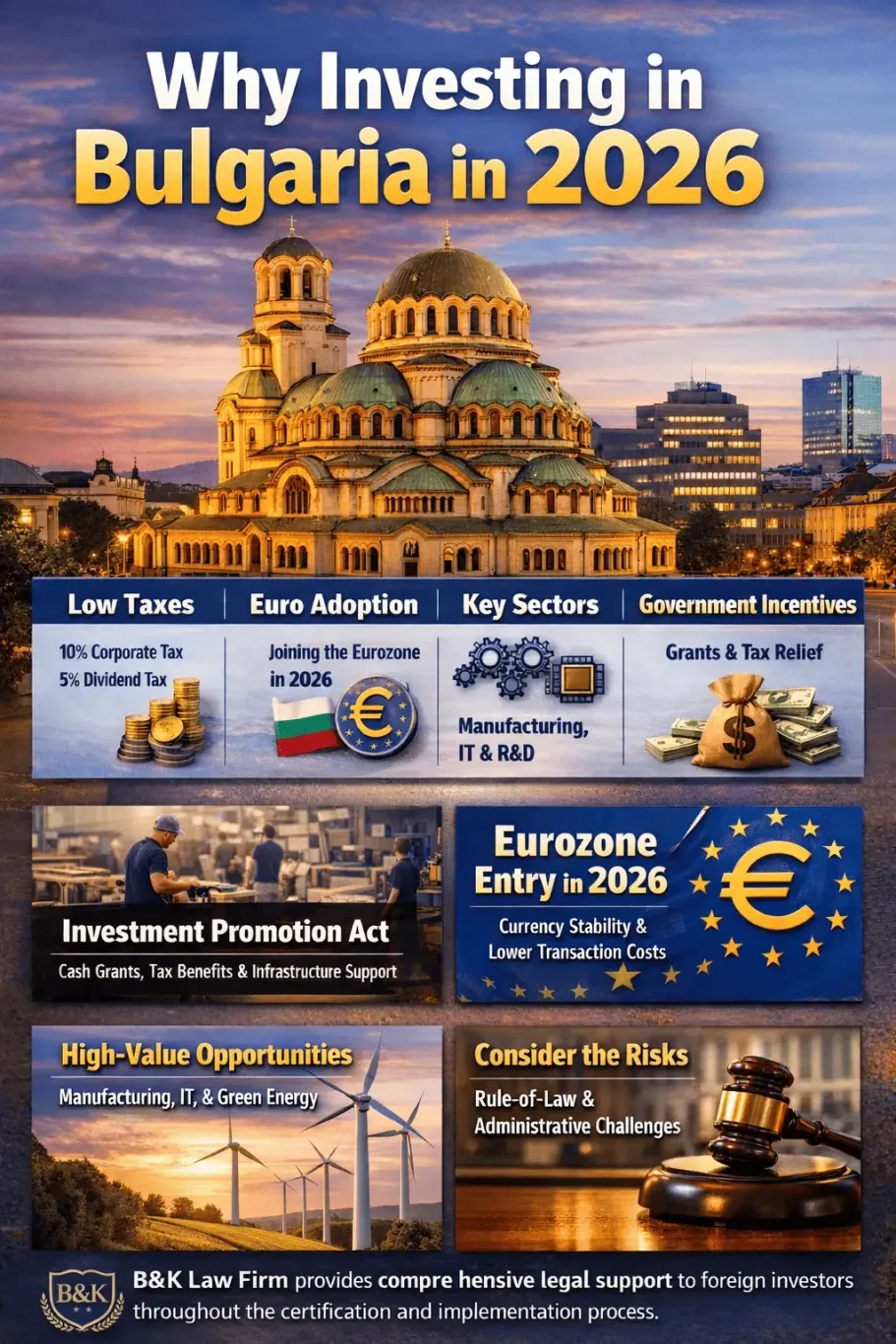
Why Investing in Bulgaria in 2026
Investing in Bulgaria remains attractive for foreign capital due to its competitive fiscal environment. The country maintains a flat 10% corporate income tax and a 5% dividend withholding tax – one of the lowest in the European Union. This favorable tax structure makes Bulgaria particularly attractive for foreign investors seeking to repatriate profits efficiently.
Bulgaria joined the Eurozone on January 1, 2026, which reduced transaction costs with key trade and investment partners. This euro adoption will eliminate currency exchange risks and enhance financial predictability for international businesses investing in Bulgaria.
Foreign and domestic investors receive equal treatment under Bulgarian law. There are generally no legal limits on foreign ownership or control of firms in Bulgaria, with limited exceptions for agricultural land ownership by non-EU entities and certain regulated sectors. The country positions itself as a regional hub for manufacturing, IT, business process outsourcing (BPO), automotive components, and R&D, supported by EU funds and an educated, cost-competitive workforce.
Investment Promotion Act: How the Governmental Incentives Work
The Investment Promotion Act serves as Bulgaria’s core framework for state support to new projects and expansions. This legislation classifies projects as Class A, Class B, or Priority depending on sector, size, and economic impact, with each class tied to specific governmental incentives.
Eligible projects typically involve manufacturing, high-tech services, R&D, education, healthcare, or renewable energy and must exceed minimum investment thresholds that vary by sector and region. Priority projects represent large scale or highly innovative investments that unlock the most generous incentive packages, including higher cash grant ceilings and bespoke infrastructure commitments.
Recent regulatory developments have streamlined the certification process. The Investment Promotion Act was amended 2022 and 2025, aiming to stimulate projects with medium and high added value, with reforms designed to reduce administrative barriers and accelerate approval timelines, aiming to boost investments in Bulgaria.
What Governmental Incentives the Bulgarian State Offers
Certified investors can combine financial and non financial governmental incentives, provided they remain within EU state aid limits. Proper planning allows stacking national, municipal, and EU funded support for a single project.
Fast-track administrative services include a dedicated relationship manager, accelerated permit handling, and coordinated support from central and local authorities for certified projects. Shorter deadlines apply for administrative services concerning procedures including under the Spatial Development Act, the Roads Act, and the Water Act.
Below-market access to land and buildings allows state or municipal property to be sold, leased, or granted with limited property rights without tender at preferential prices, subject to statutory floors. This represents a significant cost advantage for capital-intensive projects.
State-funded infrastructure means the government or municipality may finance roads, energy, water, and sewage connections to the project site, reducing upfront capital expenditure and implementation risk. This support proves particularly valuable for greenfield manufacturing facilities.
Cash grants have been expanded through recent reforms, allowing non-repayable grants covering a significant share of eligible costs, especially for manufacturing, education, and R&D projects that meet Priority criteria.
Support for jobs and training enables investors in Bulgaria to receive aid for employee training and partial reimbursement of employer social-security contributions for new jobs, typically for 12–24 months. Financial support is available for professional qualifications training of people employed in newly created positions.
Tax Incentives and Regional Focus
Beyond direct governmental incentives, the tax system itself provides powerful advantages, especially in regions with higher unemployment. Strategic location and structure choices can achieve effective tax rates below the headline 10% corporate rate.
Corporate tax remissions allow manufacturing companies in high-unemployment regions to have corporate tax effectively reduced or remitted, provided the saved tax is reinvested in eligible assets. This creates a virtuous cycle of reinvestment and growth.
Accelerated depreciation qualifies certain investments for faster tax depreciation up to 50% per year which improves early-stage cash flow and net present value, a critical advantage for capital-intensive projects.
Large investment VAT relief benefits very large projects meeting specific thresholds for value, jobs, and implementation period. A special procedure allows for tax incentives in relation to investment projects that have secured financing, with VAT charged by the VAT registered person when importing goods.
Special Considerations for Asian Investors and China Trade
For investors importing from China particularly for assembly and manufacturing operations Bulgaria presents both opportunities and regulatory considerations that shape project economics.
China-Bulgaria trade dynamics: Bilateral trade reached $4 billion in 2024, growing from under $2 billion in 2015. However, Bulgaria maintains a significant trade deficit, importing $5.63 billion in 2024 while exporting $1.54 billion. This imbalance reflects Bulgaria’s role as a European assembly and distribution hub for Asian components.
Strategic rationale for Chinese sourcing: Several Chinese manufacturers have announced investments in Bulgaria specifically to circumvent EU import restrictions while accessing the single market. A planned €1 billion investment in aluminum chassis manufacturing for electric vehicles exemplifies this strategy. Bulgaria’s combination of low labor costs, EU membership, and governmental incentives creates compelling economics for Asian parts assembly.
Regulatory framework: The FDI screening mechanism requires scrutiny of investments with non-EU ultimate control, but applies primarily to equity ownership rather than supply relationships. Companies importing parts from China for assembly in Bulgaria face minimal screening barriers, provided the Bulgarian entity remains EU-controlled. This regulatory clarity favors assembly and manufacturing models over direct Chinese investment structures.
Bulgaria-China strategic partnership: Elevated to strategic partnership status in 2019, the bilateral relationship emphasizes technological cooperation and infrastructure development. Recent intergovernmental commission meetings focused explicitly on expanding Bulgarian manufacturing exports to China and attracting Chinese investment in automotive, electronics, and renewable energy sectors.
Practical advantages: Bulgaria’s location provides efficient logistics for both Asian imports (via Black Sea ports) and European distribution (via road and rail corridors). The 2026 euro adoption will eliminate currency risk for Chinese suppliers invoicing in euros, while governmental incentives offset the cost disadvantage versus direct Asian manufacturing.
Economic Outlook and Investment Timing
Understanding Bulgaria’s macroeconomic trajectory is essential for investment timing and risk assessment. The European Commission forecasts GDP growth of 2.7% in 2026, supported by private investment, EU funds absorption, and euro adoption momentum. However, several factors merit careful attention.
Growth drivers: Private consumption remains robust, fueled by wage growth and improving business confidence ahead of euro adoption. EU Recovery and Resilience Plan implementation accelerated in 2025, with infrastructure investments providing tailwinds for construction and related sectors. Export growth is expected to resume after temporary contractions in early 2025 due to maintenance work by major exporters.
Fiscal considerations: The budget deficit is projected at 2.7% of GDP in 2026, within EU limits but reflecting continued spending pressures. Public debt remains among the EU’s lowest at approximately 30.6% of GDP in 2026, providing fiscal headroom for additional support programs. Defense spending will increase significantly, potentially creating procurement opportunities in specialized sectors.
Inflation trajectory: After peaking above 15% in 2022, inflation is expected to ease to approximately 3% by end-2026. This stabilization supports the euro adoption case and reduces uncertainty for long-term investment planning. Wage growth continues to outpace inflation as labor markets remain tight, creating both cost pressures and consumption support.
Political stability: Bulgaria has experienced eight general elections since 2021, creating policy uncertainty that delays reforms and impacts foreign direct investment flows. However, euro adoption and OECD accession processes provide external anchors that should accelerate institutional improvements regardless of domestic political turbulence.
Optimal investment window: The period from early 2026 through 2027 represents a strategic entry point. Euro adoption eliminates currency risk, Schengen membership (achieved in 2024) reduces border friction, and accelerating EU funds absorption creates co-investment opportunities. Political uncertainty may actually improve negotiating leverage for investors as municipalities and national authorities compete to demonstrate economic progress.
How to Structure Your Investment to Maximize Governmental Incentives
To capture the value of governmental incentives, investors in Bulgaria need more than a benefits checklist they need a structure aligned with both IPA rules and practical realities.
Start early with certification: Engage with the Invest Bulgaria Agency at concept stage to confirm eligibility, class designation (A, B, or Priority), and realistic timelines for permits and infrastructure delivery. Early engagement often determines whether projects qualify for the highest tiers of support.
Choose location strategically: Weigh higher governmental incentives and tax remissions in high-unemployment regions against logistics, labor availability, and exposure to local administrative risk. Regional disparities in governance quality can significantly impact project execution.
Build compliance into the financial model: Allocate budget and time for local legal, tax, and regulatory support to navigate frequent legislative changes and ensure aid conditions are respected over the full monitoring period. Non-compliance can trigger claw back provisions. B&K Law Firm specializes in assisting foreign investors in Bulgaria with Investment Promotion Act certification, governmental incentives structuring, and compliance frameworks tailored to Bulgaria’s regulatory environment.
Rely on dispute prevention, not only dispute resolution: Detailed contracts, clear conditions for state aid and infrastructure delivery, and careful documentation of communications with authorities reduce exposure to enforcement and delay issues. Given judicial challenges, prevention proves more effective than litigation.
Prepare for euro conversion: From January 2026, Bulgaria officially adopted the euro, eliminating currency exchange risks, enhancing financial transparency, and improving investor confidence. Businesses should prepare accounting systems and contracts for the fixed conversion rate of 1 EUR = 1.95583 BGN.
Bulgaria’s Nearshoring Advantage: The Hidden Opportunity
A critical trend reshaping Bulgaria’s investment landscape is the nearshoring wave from Germany and Western Europe. With geopolitical tensions disrupting Asian supply chains, Bulgaria has emerged as Europe’s manufacturing alternative to farshore dependencies.
The nearshoring case is compelling: Average industrial labor costs of €8-€10 per hour versus €35-€45 in Germany combined with EU membership create a cost-competitive, barrier-free production base. German manufacturers including Liebherr, Festo, Rheinmetall, and Schneider Electric have established major operations, creating supplier clusters and vocational training networks that reduce setup friction for new investors.
Speed-to-market advantage: Manufacturing facilities can go from site selection to production-ready in under 12 months, a pace few Central and Eastern European countries match. The Trakia Economic Zone – Southeast Europe’s largest industrial area with over €3 billion in investment demonstrates this execution capacity, attracting eleven new industrial parks funded by €105 million in government grants.
Strategic connectivity: Bulgaria’s location provides dual-port access through Greece’s Thessaloniki and Romania’s Black Sea gateways, with ongoing development of Transport Corridor VIII further reducing freight costs. This positions Bulgaria uniquely for investors sourcing components from Asia while serving European markets.
Key Sectors for Governmental Incentives
Bulgaria’s governmental incentives framework particularly favors sectors where competitive advantage meets strategic national priorities:
Manufacturing and automotive components dominate foreign investment, with automotive parts now the primary recipient sector. Established supply chains serve major European OEMs, while governmental incentives provide both direct grants and regional tax remissions. Chinese companies have announced significant investments in automotive manufacturing to circumvent EU import restrictions while accessing the single market.
IT and business process outsourcing position Bulgaria as Europe’s second-fastest growing tech center after the capital Sofia. The ICT sector revenue surged 300% over seven years to €2.5 billion, leveraging an educated, bilingual workforce fluent in both technical skills and German business culture. Priority project status unlocks maximum governmental incentives for high-value service centers.
Electronics and semiconductors reflect Bulgaria’s integration into global supply chains. The country has become a nearshoring hub for European tech firms, with major investments in computer, electronic, and optical product manufacturing qualifying for accelerated depreciation and infrastructure support.
Renewable energy and green technology align with Bulgaria’s National Recovery and Resilience Plan target to add 4,000 MW of renewable capacity by 2026. Solar PV generation increased 33% in 2022, with governmental incentives and EU funding creating opportunities in photovoltaic systems, energy storage, and hydrogen infrastructure.
Conclusion: Is Investing in Bulgaria the Right Choice for Your Project?
For investors in manufacturing, IT, BPO, automotive components, electronics, or renewable energy, Bulgaria offers a unique value proposition that becomes increasingly compelling as Europe restructures supply chains away from geopolitical risk.
The investment case strengthens in 2026: Euro adoption eliminates currency risk. Schengen membership reduces border friction. Accelerating EU funds absorption creates co-investment opportunities. The nearshoring trend from Germany and Western Europe validates Bulgaria’s manufacturing competitiveness. Governmental incentives provide 10-30% cost advantages when properly structured.
The mathematics work for specific profiles: Investors seeking to combine Asian component sourcing with European assembly and distribution find Bulgaria’s 10% corporate tax, 5% dividend tax, and substantial governmental incentives difficult to replicate elsewhere in the EU. The ability to go from site selection to production in under 12 months while accessing €105 million in new industrial park funding creates execution advantages that offset governance risks for companies with strong compliance frameworks.
Required risk management: Success demands realistic governance expectations, robust legal structuring, and proactive engagement with the Invest Bulgaria Agency from concept stage. Political instability creates uncertainty but also negotiating leverage. Judicial weaknesses require dispute-prevention strategies rather than litigation reliance. Demographic decline means automation and productivity investments should supplement labor cost arbitrage.
Strategic positioning: Companies that enter Bulgaria’s market in 2026-2027 after euro adoption but before the nearshoring wave fully materializes can secure optimal sites, negotiate favorable terms, and establish first-mover advantages in supplier networks. The window between euro stability and market saturation may be narrow.
Approached with clear-eyed assessment of both opportunities and constraints, Bulgaria’s governmental incentives regime can transform competitive European projects into exceptional ones. The combination of fiscal advantages, strategic location, EU integration, and active state support creates a value proposition that—properly executed – few European jurisdictions can match.
For expert guidance on navigating Bulgaria’s Investment Promotion Act, structuring governmental incentives packages, and ensuring regulatory compliance, B&K Law Firm provides comprehensive legal support to foreign investors throughout the certification and implementation process.