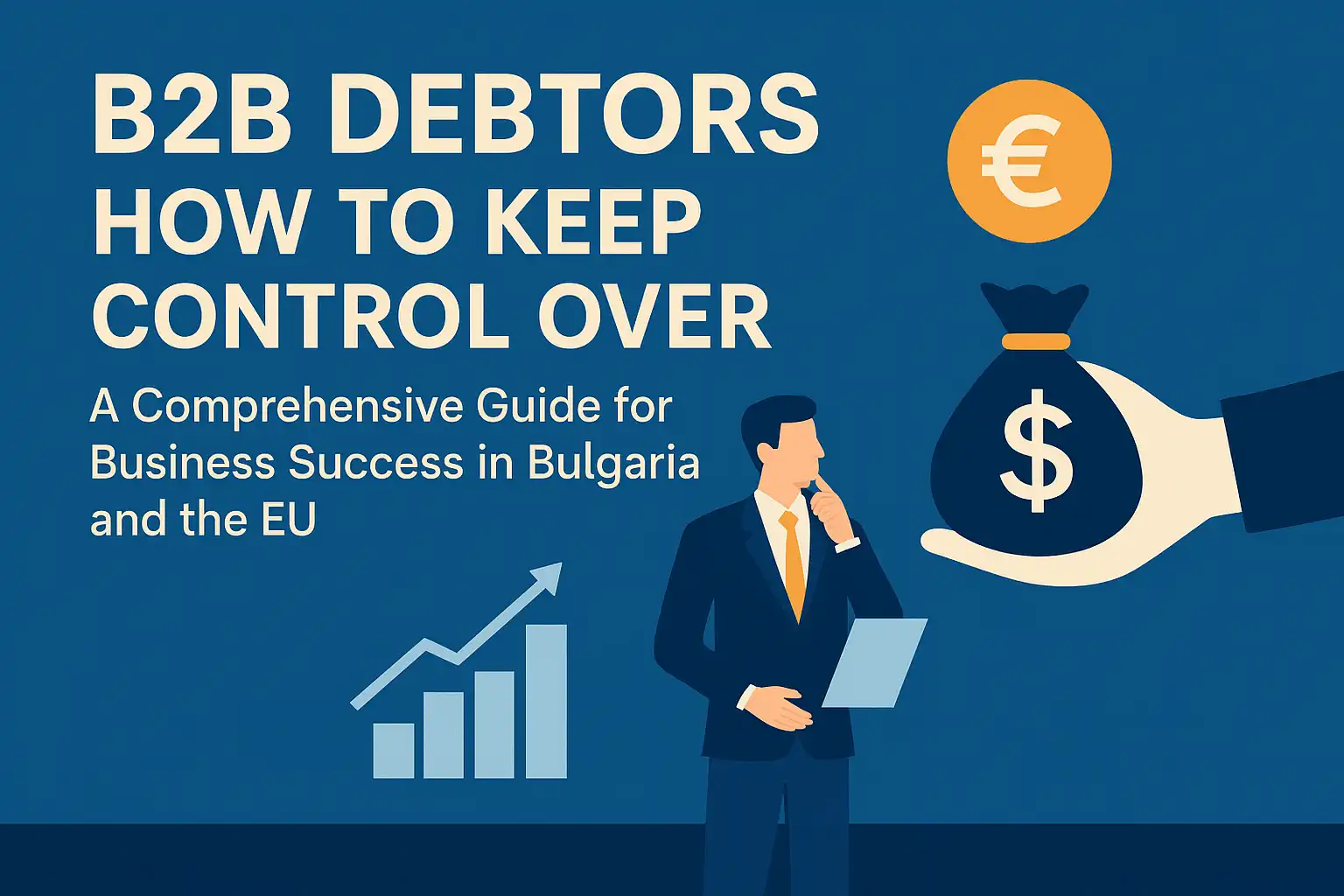
A Comprehensive Guide for Business Success in Bulgaria and the EU
Managing business to business B2B debtors effectively is one of the most critical yet often overlooked aspects of running a successful company. In the European market, especially Bulgaria, where payment terms commonly extend from 30 to 90 days and transaction values are often significant, poor debtor control can severely disrupt business cash flow, threaten operations, and attract legal scrutiny. This comprehensive guide explores industry best practices tailored for Bulgaria and the EU to maintain control over B2B debtors, ensure timely invoice payments, and safeguard your company’s financial health.
The recent EU Payment Observatory Annual Report 2025 shows that:
- More than half of European companies, 52%, indicate that they are facing issues due to latepayments in 2024. This is five points more than in 2023 and 10 points higher than in 2021, whichwas when the situation started to worsen.
- In 19 Member States, the share of companies reporting problems linked to late payments hasincreased. The worst situations are reported in Poland, the Czech Republic and Luxembourg, whilethe Netherlands and Bulgaria record the lowest share of impacted companies. A PDF copy of the Report can be read here Summary 2025
Understanding B2B Debt Management in Bulgaria and the EU: Why It Matters
B2B debtors management (accounts receivable management) in Bulgaria and across the EU is a systematic process of overseeing, monitoring, and collecting payments owed by business clients for goods or services delivered on credit. The complexity of EU regulations, such as Directive 2011/7/EU on combating late payment in commercial transactions, and national Bulgarian regulations, means compliance and diligence are essential.
- Late payments are a chronic issue in the EU. According to the European Commission, over 55% of B2B invoices are paid late, directly impacting liquidity and potential business survival.
- Under Bulgarian law, the Commercial Act PDF File (Търговски закон) sets out requirements for commercial agreements, including payment terms, while late payment rules reflect EU harmonization.
- The EU Late Payment Directive requires that, in the absence of contractual agreement, default interest is due 30 days post-invoice. In Bulgaria, this is implemented via the Obligations and Contracts Act (Закон за задълженията и договорите) and various sectoral regulations.
- Effective debtor management ensures proper cash flow, risk mitigation, and legal protection, while supporting stable commercial relationships.
Step 1: Establish Robust Trade Credit Policies and Payment Terms (Bulgaria & EU)
- Legal Review of Contracts: All contract terms should be reviewed by lawyers familiar with Bulgarian and EU commercial law. Clearly define payment terms, due dates, accepted payment methods, default interest rates, and consequences of late payment – according to both the Commercial Act and EU directives.
- Formalize Payment Terms: Standard terms (Net 30/60/90) are common, but must comply with minimum requirements. Exceptions for key clients should always be properly documented and legally reviewed.
- Credit Limits: Set credit limits per client based on risk, order history, and previous payment performance, and ensure these are enshrined in a written, signed agreement.
- Segment Customer Policies: Differentiate by client size, history, and risk category. Keep records to demonstrate compliance capabilities in case of audit.
- Transparency and Documentation: All credit decisions must be justified, documented, and legally defensible under local (BG) and EU rules.
Step 2: Implement Thorough Credit Assessment and Continuous Monitoring
- Due Diligence: Require and verify full legal entity names, UIC numbers (Уникален идентификационен код), VAT registration, up to date financial statements, and bank references. Validate registration with the Bulgarian Registry Agency or respective EU authority.
- Credit Reports and References: Utilize European databases (e.g., Dun & Bradstreet, Experian, Coface, Intrum) and contact other EU suppliers for trade references.
- Financial Analysis: Review liquidity ratios, debt-to-equity, historical payment performance, and business reputation.
- Ongoing Monitoring: Annual or biennial reassessment is strongly recommended, especially in volatile economic times.
- Risk Scoring: Adopt documented and valid risk assessment models, applying consistent, objective criteria in line with GDPR requirements for data handling.
Step 3: Optimize Your Invoicing Process for Speed, Legality, and Accuracy
- Immediate Invoicing: Invoice immediately upon delivery of goods/services. Under Bulgarian and EU law, the invoice date sets the official timeline for payment and potential default interest accrual.
- Invoice Completeness: Include UIC, VAT details, purchase order numbers, contract references, clear payment instructions, and bank accounts (IBAN/BIC) to avoid processing delays.
- Electronic Invoice Delivery: Bulgaria and the EU recognize electronic invoices as legally valid. Use e-invoicing platforms for increased traceability and efficiency.
- Automated Systems: Automation ensures timely, error-free billing, and consistency – crucial for demonstrating diligence if you need to defend your process in court.
- Professional Templates: Use lawyer-approved templates with all mandatory fields as per Bulgarian and EU VAT and invoice requirements.
Step 4: Monitor Payments with Strategic Metrics and Legal Awareness
- Days Sales Outstanding (DSO): Monitor regularly; rising DSO is a warning sign.
- Aging Reports: Prepare weekly, categorizing overdue invoices (current, 1–30 days, 31–60, 61–90, 90+).
- Collection Effectiveness Index (CEI): Use as a tool for internal process improvement.
- Customer Patterns: Investigate sudden payment delays; these may be early warnings of financial difficulty.
- Risk-Based Focus: Prioritize collection work based on the greatest legal and financial exposure.
Step 5: Establish Structured and Legally-Compliant Collection Procedures
- Pre-Due Contact: Around day 14–21 of a Net 30 term, confirm invoice receipt and upcoming payment.
- Due Date Reminders: Send reminders 2–3 days prior to due date.
- Immediate Follow-up: For late payments, communicate promptly – polite but firm.
- Formal Written Reminders: From day 7 overdue, issue a second, legally-worded reminder referencing your contract, the EU Directive, and applicable Bulgarian law.
- Escalation: By day 30 overdue, issue a FINAL legal demand (“Предизвестие за изпълнение”/Final Payment Notice) and consider suspending further deliveries.
- Documentation: Maintain detailed records of all communications, as these are vital if litigation becomes necessary.
- Legal Escalation: If payment has not been received following final reminders, immediately consult your legal counsel or a reputable law firm specializing in commercial recovery in Bulgaria and the EU.
Step 6: Leverage Technology and Automation
- Modern AR Software: Choose products compliant with GDPR and integrated with your accounting/ERP systems.
- Automated Communication: Allow for automatic emailing/SMS of reminders.
- Self-Service Portals: Enable clients to view invoices and make payments online.
- Multiple Payment Methods: Bank transfer, card, SEPA (EU-wide), and e-money solutions (compliant with EU PSD2).
- Real-Time Tracking: Technology allows instant visibility and reduces manual workload.
Step 7: Maintain Professional Relationships While Enforcing Your Rights
- Gradual Escalation: Start gently, increase firmness step by step.
- Personalized Communications: Be human and respectful – even in difficult cases.
- Dispute Resolution: Address disputes fast; unresolved issues justify withholding payment under Bulgarian law.
- Acknowledgement: Thank prompt payers; positive reinforcement pays dividends.
- Payment Plans: For temporary hardship, consider installment agreements – preferably drawn or vetted by legal professionals.
Step 8: Strategic Incentives & Payment Term Management
- Early Payment Discounts: Offer only if justifiable versus your working capital needs and calculated as per Bulgarian/EU accounting rules.
- Discount Enforcement: Automated validation ensures only timely payments qualify.
- Dynamic Discounting: Adaptable discounts can align with both parties’ needs.
- Negotiated Terms: For major or strategic customers, negotiate openly, document changes, and seek legal review.
Step 9: Proactive Risk Management and Regular Portfolio Reviews
- Quarterly Reviews: Regular assessment identifies concentration risk and deteriorating accounts.
- Bad Debt Reserves: Provision in compliance with Bulgarian accounting standards and IFRS if required.
- Trade Credit Insurance: For large/high-risk exposures, consider specialist insurance – ensure the policy covers Bulgaria and your target EU markets.
- External Risk Factors: Track business partner status via trade registers, insolvency lists, and sector risk analytics.
- Credit Limits: Adjust only after formal reassessment and legal sign-off.
Step 10: Legal Escalation – Your Lawyer is Your Best Ally
When 30, 60, or 90 days pass with no payment and all internal escalation steps fail, your next step in Bulgaria and the EU is to immediately consult a specialized commercial lawyer. Professional legal intervention:
- Ensures all steps are fully compliant with Bulgarian and EU law (including GDPR).
- Maximizes chances of recovery, whether through court action, European Small Claims Procedure, or court order for payment (Заповед за изпълнение).
- Protects your business reputation and legal interests.
- WARNING: Never pursue court collection without prior legal assessment, as procedural errors can jeopardize recovery or even result in counterclaims and procedural sanctions.
Step 11: Continuous Process Improvement and Legal Compliance
- Analyze Trends and Performance: Use data to refine credit policies.
- Customer Feedback: Improves AR systems and client experience.
- Benchmark: Compare KPIs to leading Bulgarian and EU businesses.
- Legal Training: Ensure team is up-to-date with latest EU/Bulgarian B2B debt and privacy laws.
- Annual Policy Review: All procedures must be updated annually and legally reviewed for ongoing compliance.
Implementing a Best-in-Class B2B Debtors Management System (Bulgaria & EU)
- Phase 1: Audit current state, processes, and legal compliance.
- Phase 2: Develop and legally review new policies.
- Phase 3: Invest in modern, GDPR-compliant AR technology.
- Phase 4: Train all relevant teams with input from legal professionals.
- Phase 5: Inform clients—always reference improvement of their experience and compliance.
- Phase 6: Launch and monitor, adjusting based on feedback and results.
- Phase 7: Embed continuous monitoring and annual legal review cycle.
Frequently Asked Questions About B2B Debt Management in Bulgaria & the EU
- Q: What makes B2B debt management in Bulgaria/EU unique?
A: Strict deadlines under EU Directive 2011/7/EU and Bulgarian national law, harmonized penalty interest, and procedural requirements for escalating collection, including legal demand notices and data protection compliance. - Q: What are standard B2B payment terms?
A: Net 30, Net 60, Net 90, with legal maximums for commercial transactions per law; interest on late payments set by statute if not otherwise agreed. - Q: How do I assess creditworthiness?
A: Credit application (incl. UIC, VAT ID), credit bureau check, bank/trade references, annual accounts, and ongoing risk-based scoring per GDPR. - Q: What metrics should I track?
A: DSO, CEI, invoice aging, bad debt ratio, and specific legal process durations – adjusted for local legal context. - Q: How can I speed up payment cycles?
A: Prompt, accurate invoicing; regular pre-due reminders; offering electronic payment options; direct AP contact; and legally robust contract terms. - Q: Should I offer early payment discounts?
A: When financially justified and in compliance with accounting standards. Ensure legal mechanisms prevent abuse. - Q: When should a customer be placed on hold?
A: Overrun credit limits, invoices overdue by for more than 30 days, deteriorating financials, or repeated breaches – after clear notice per Bulgarian/EU law. - Q: How do I balance collections with relationships?
A: Combine graduated, respectful escalation with strict documentation and always keep communications professional and legally sound. - Q: What technology is recommended?
A: Certified, GDPR-compliant AR or ERP system; e-Invoicing and electronic payment integrations; real-time credit management tools. - Q: When should I escalate to a lawyer?
A: When internal collection fails, if there’s a complex dispute, or at any sign of bankruptcy/involvency – always before initiating legal proceedings. It’s always better to coordinate with your lawyer on the go, its cheeper at the end. - Q: How do I minimize bad debts?
Strong contracts, ongoing monitoring, fast dispute resolution, structured escalation, risk reserves, and, where appropriate, insurance. - Q: Are there special court procedures for B2B collections?
A: Yes: In Bulgaria, fast-track payment order procedures (Заповед за изпълнение), European Small Claims Procedure, and cross-border enforcement per the Brussels I Regulation. - Q: Do I have to notify customers of intended legal action?
A: Bulgarian law and EU best practice require formal final written notice before court – failure to notify can compromise your claim. - Q: How do GDPR and data protection impact collection?
A: All debt collection and credit assessment processes must comply with GDPR – ensure legal review of data flows and privacy notices.
Ready to Take Control of Your B2B Receivables From the Beginning?
Don’t leave your cash flow and business stability to chance. Belcheva & Karadjova Law Firm is a recognized leader in B2B debt recovery and commercial law in Bulgaria and the EU. Our lawyers combine local expertise, advanced AR best practices, and international perspective to protect your business, recover debts efficiently, and ensure compliance with every aspect of Bulgarian and European legislation.
Contact Belcheva & Karadjova Law Firm today to strengthen your debtor management, resolve outstanding payments, and secure the legal foundation for your business growth.