Introduction: The Bulgarian Lawyer as a Mirror of Power
The figure of the Bulgarian lawyer appeared late in our history – but behind it stood centuries of development in judicial customs, power, and law. The legal profession has always been like a mirror: when the state was strong and free, the Bulgarian lawyer was independent and autonomous; when power became authoritarian, he was the first to be oppressed.
Today, Bulgaria has over 13,000 lawyers organized in 25 bar associations. But how did it all begin? What path did the Bulgarian lawyer travel from petition writer to independent professional association?
Medieval Bulgaria: Courts Without Bulgarian Lawyers
The Judicial System Without Lawyers
In the First and Second Bulgarian Kingdoms, judicial power was part of the personal authority of the ruler – khan, prince, tsar. He was the supreme judge, and below him operated boyars, local administrators, and ecclesiastical courts.
Cases were resolved according to customary law – unwritten norms for:
- Honor and dignity
- Blood feuds and compensation
- Property disputes
- Punishments for crimes
After Christianization in 864 AD, written sources appeared – the Bulgarian translation of the Byzantine Ecloga and the “Law for Judging People,” but they still did not envision the figure of the Bulgarian lawyer in the modern sense.
How Did People Defend Themselves Without Lawyers?
The process was accusatorial and adversarial: parties presented their claims, the judge questioned witnesses and decided. Evidence consisted of:
- Witness testimony
- Oaths and vows
- Ordeals (trial by ordeal) – trials by hot water, hot iron
There were no lawyers in the modern sense – there was no figure of an independent jurist who professionally defended the interests of a party. Customarily:
- A person defended themselves alone
- Relied on a relative or influential patron (boyar, confessor), but this was not a profession
Social Status as “Evidence”
A curious detail: in medieval cases, the weight of testimony depended on social status. A nobleman’s word weighed more than a peasant’s. This was the exact opposite of the idea of equality of parties that the Bulgarian lawyer would later bring.
The Ottoman Period: The Qadi Court and the First “Defenders”
How the Ottoman Court Worked in Bulgarian Lands
After falling under Ottoman rule (1396), Bulgarian lands fell into a system where the main judge was the qadi – a Muslim jurist applying Sharia and imperial laws.
Features of the qadi court:
- Cases began orally, often without written petition
- The process was quick and oral
- Muslim witness testimony had preferential weight over Christian testimony
- The qadi kept a court register (defter) – today valuable sources for social life
In parallel operated Christian community courts (guild, ecclesiastical, municipal), which resolved family and minor disputes according to Bulgarian customary law.
Petition Writers – The First “Quasi-Lawyers”
In the Ottoman system, there was not yet a legally recognized Bulgarian lawyer, but people appeared with a quasi-legal role:
Petition writers were literate individuals (often Greek or Bulgarian priests, teachers, craftsmen) who, for payment:
- Wrote complaints and petitions to the qadi
- Knew the practice and formulas
- Played the role of “legal intermediaries”
- Had no official status or guarantees
Toward the end of the Ottoman era, the Tanzimat reforms and the Statute on Lawyers of 1876 introduced professional lawyers into the imperial system for the first time. They were admitted before civil courts and this opened the door for the Bulgarian lawyer.
Iliya Tsanov – The Hero Who Could Have Saved Levski
Iliya Tsanov is often cited as the first Bulgarian lawyer in spirit and the most dramatic figure in the early history of the legal profession.
Who Was Iliya Tsanov?
Born into a teacher’s family, Iliya Tsanov received a solid legal education. In 1876, when a trial was held in Ruse against captured insurgents from Botev’s, Tanyo’s, and Patrev’s detachments, he undertook their defense.
The Dramatic Trial in Ruse (1876)
The situation was hopeless:
- 13 gallows had already been erected in Ruse before the trial began
- Iliya Tsanov was expected only to make a formal plea for mercy
- Instead, he delivered a brilliant defense in perfect Turkish
He managed to:
- Transform the cases from political to “common crimes”
- Save the accused from death sentences
- Receive recognition from the Austro-Hungarian diplomat as a lawyer “of the Demosthenes type”
The Tragic End
Iliya Tsanov often said: “If I had been in Sofia at that time, I would have saved the Apostle from the gallows!” – referring to Vasil Levski.
After the trial, he:
- Lost his job due to defending insurgents
- Died in poverty in 1901
- Remained in history as the first true Bulgarian lawyer
Although he operated within Ottoman law, his role already resembled that of the modern Bulgarian lawyer – a jurist who boldly defended the accused against authority.
After Liberation (1878-1888): From “Trustees” to Lawyers
Temporary Russian Administration and the Figure of “Trustee”
After Liberation (March 3, 1878), the Russian Temporary Administration organized courts according to the Russian model. In this first transitional moment:
- Any adult, literate person with a “good name” could be a trustee
- The trustee represented other persons before the court
- There was not yet a strict requirement for education or status
- The profession was semi-open
Plovdiv – Pioneer of the Bulgarian Lawyer
On August 2, 1878, in Plovdiv, General-Adjutant Prince Dondukov-Korsakov signed a “Journal Resolution” that regulated the activity of lawyers. Plovdiv became the first city in liberated Bulgarian lands with a normative act for lawyers.
The Law on Courts (1880)
The Law on the Organization of Courts (1880) structured the judicial system – justices of the peace, district courts, appellate courts, and Supreme Court of Cassation. In this context:
- The “Bulgarian lawyer” appeared as a figure, but without an independent law
- Requirements were relatively low – education and “good morals” were sufficient
- In the late 1870s and early 1880s, the Bulgarian lawyer was more of a practitioner than an institutionally guaranteed defender
The First Law on Lawyers (1888): Birth of the Profession
The Historic Date: November 22, 1888
On November 22, 1888, the Fifth National Assembly adopted the first Law on Lawyers, which established a clear framework for the profession of Bulgarian lawyer. Therefore, this date is celebrated as Day of the Bulgarian Bar.
Who Could Become a Bulgarian Lawyer According to the 1888 Law?
The law introduced specific requirements that shaped the professional profile of the Bulgarian lawyer:
Education
- Higher legal education (in Bulgaria or abroad)
- Law degree plus state examination on the Law on Courts
- For lower educational requirements – possibility through examination and 3 years of practice (transitional measure)
Personal Qualities
- Bulgarian citizenship
- Majority age (over 21 years)
- No conviction for theft, fraud, perjury
- No insolvency or guardianship
Incompatibilities
State officials, magistrates, and other public positions could not practice law – the Bulgarian lawyer had to be independent.
The Procedure: From Petition to Oath
To become a Bulgarian lawyer, the law required:
- Petition to the district court with attached diplomas and certificates
- Court decision; refusal could be appealed to the appellate court
- Taking an oath of loyalty to the laws and honesty
- Enrollment in the list of lawyers at the respective court
The Bulgarian lawyer was “assigned” to a district court – there he had the right to practice and appear before higher instances.
Rights, Obligations, and Discipline
The law already viewed the Bulgarian lawyer as a public figure:
- Obligation of attorney-client privilege – the basis of trust
- Obligation to accept court-appointed defenses for the poor (early form of legal aid)
- Possibility of disciplinary sanctions: warning, reprimand, temporary suspension of rights
Interesting detail: As early as 1888, the law assumed public trust – the Bulgarian lawyer was conceived as a figure who had to be morally pure, not just a qualified jurist.
Self-Governance and Prestige (1897-1944): The Bulgarian Lawyer as a Public Factor
The Sofia Bar Council and the First Associations
On October 11, 1897, by order of the Sofia District Court, the first Sofia Bar Council was created:
Leadership:
- Chairman: Dr. Dimitar Grekov
- Members: Dr. Vasil Radoslavov, Dr. Sava Ivanchev, Dr. Stoyan Danev, Dr. Konstantin Pomyanov, Ivan Plakunov, Gavril Oroshakov
Symbolism of the Beginning:
- At that time, Sofia had only 59 lawyers
- All 7 members of the Council had the title “Dr.” (Doctor)
- Small but highly politically and intellectually active group
- Many of them became prime ministers, ministers, diplomats
This showed how the Bulgarian lawyer was a path to power and public influence.
The Law on Lawyers of 1925: Independent Bar Association
The law of 1925 is considered the foundation of modern Bulgarian legal practice:
Key Innovations:
- Introduced bar associations as legal entities
- Mandatory membership for every Bulgarian lawyer
- Elected bodies of the associations
- Created the Supreme Bar Council – national body of the legal profession
- Mandatory higher legal education
- Strict moral criteria
Thus, the Bulgarian lawyer was no longer simply “a person with the right to represent before court,” but a member of a self-governing professional association that protected the rights of its members and its independence from the state.
The Union of Bulgarian Lawyers (1920-1944)
In 1920, the Union of Bulgarian Lawyers was created, which:
- Participated in legislative initiatives
- Defended Bulgarian lawyers in conflicts with authorities
- Organized professional and social events
- Published publications and training materials
During this period, the Bulgarian lawyer was a figure of high prestige – often combining the profession with political career, journalism, participation in public debates.
After September 9, 1944: From Independent to “Assistant to the Socialist Court”
The Socialist Concept of the Bulgarian Lawyer
After the establishment of the communist regime, the legal profession was subordinated to the idea of “socialist legality.”
Dramatic Changes:
- The independence of the Bulgarian lawyer was restricted
- He was viewed as part of the state mechanism, not as a counterpoint to authority
- New acts (from 1947 onward) placed associations under the supervision of the Minister of Justice
The Bulgarian lawyer was no longer a free professional, but an “organized profession under control.”
Decrees and Laws from the 1950s and 1970s
In 1952 and later in 1976, acts were issued that:
- Transformed bar associations into structures very close to state organizations
- Limited the possibilities for free practice
- Abolished the right to public criticism of authority
In practice, the Bulgarian lawyer could defend on procedural issues, but not question political persecution.
The contrast was striking:
- 1925: Independent association with high self-awareness
- 1952: Under strict control of the Minister of Justice
- This illustrated the thesis: “when power is authoritarian, the Bulgarian lawyer is the first to be oppressed”
After 1989: Restoration of Independence
The Law on the Bar of 1991
After the fall of the regime, democratic changes reached the Bulgarian lawyer. The Law on the Bar of 1991:
- Restored full self-governance
- Associations and the Supreme Bar Council became autonomous again
- Established the legal profession as an independent, self-governing, and free profession
The Modern Bulgarian Lawyer
Today’s Law on the Bar (promulgated 2004, as amended):
Requirements:
- Completed legal education
- Experience in the legal profession
- Successfully passed bar examination
- Registration in the bar association register
Guarantees:
- Attorney-client privilege is constitutionally protected (Art. 30, para. 5 of the Constitution)
- Right to free choice of lawyer
- Inviolability of lawyer files and correspondence
- Participation in drafting laws
The Bulgarian Lawyer in the European Context
Bulgarian legal practice is integrated into the European network:
- Cases before the EU and the European Court of Human Rights (ECHR)
- Cross-border corporate disputes
- International tax and commercial law
- Digital economy and tech law
Current Data:
- Over 13,000 lawyers in the country
- 25+ bar associations in cities
- The Sofia Bar Association is the largest
- November 22 – Day of the Bulgarian Bar
The Line of Development: From Absence to Institutional Independence
If we look through the entire history of the Bulgarian lawyer:
The Middle Ages (7th-14th centuries)
- Courts without lawyers
- Reliance on social status, not rights
- Defense through relatives and patrons
The Ottoman Period (14th-19th centuries)
- First “intermediaries” – petition writers
- Heroes like Iliya Tsanov, but without institution
- Qadi court and limited self-governance
After Liberation (1878-1888)
- Rapid transition to European model
- First Law on Lawyers – November 22, 1888
- The Bulgarian lawyer acquired a clear legal framework
The Golden Age (1925-1944)
- The legal profession became a true professional association
- High public prestige
- Self-governance and independence
Under Communism (1944-1989)
- Subordinated to the state
- Limited independence
- “Assistant to the socialist court”
After 1991 to Today
- Again an independent pillar of the rule of law
- European integration
- Contemporary challenges
Conclusion: The Bulgarian Lawyer – Defender of Rights
The history of the Bulgarian lawyer is not only professional – it is a history of the struggle for law against arbitrariness.
Key Lessons
Almost always, when the Bulgarian lawyer was strong, citizens’ rights were better protected.
Today, the Bulgarian lawyer:
- Defends constitutional rights
- Guarantees access to justice
- Participates in building the rule of law
- Is part of the European legal community
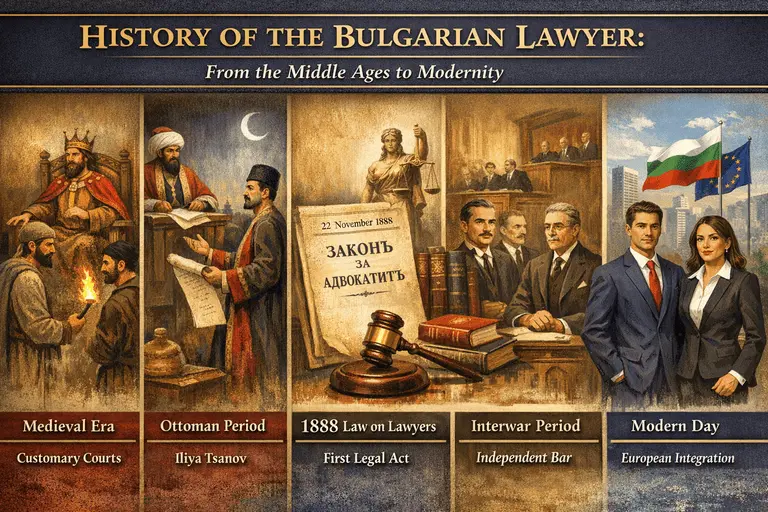
Visual Table: Stages in the Development of the Bulgarian Lawyer
| Period | Status of Lawyer | Key Moment |
|---|---|---|
| 7th-14th c. | Did not exist | Customary law |
| 14th-19th c. | Petition writers | Iliya Tsanov (1876) |
| 1878-1888 | Trustees | – |
| 1888 | Profession | First law (11.22.1888) |
| 1925 | Association | Self-governance |
| 1944-1989 | Under control | Socialism |
| 1991-present | Independent | Democracy |
Frequently Asked Questions About the Bulgarian Lawyer
When did the first Bulgarian lawyer appear?
The first Bulgarian lawyer in spirit was Iliya Tsanov, who defended insurgents in Ruse in 1876. The profession was officially regulated with the Law on Lawyers of November 22, 1888.
What is celebrated on November 22?
November 22 is the Day of the Bulgarian Bar – the date on which the first Law on Lawyers was adopted in 1888.
How many lawyers are there in Bulgaria today?
As of 2024, Bulgaria has over 13,000 lawyers organized in over 25 bar associations.
Who were the first lawyers in Sofia?
The first Sofia Bar Council (1897) was led by Dr. Dimitar Grekov, with members Dr. Vasil Radoslavov, Dr. Sava Ivanchev, Dr. Stoyan Danev, and others – a total of 59 lawyers.
Why is the Bulgarian lawyer important for democracy?
The Bulgarian lawyer is a pillar of the rule of law – guarantees the right to defense, balance between citizen and authority, and access to justice.
Sources and Further Reading
This article used:
- The Influence of Roman Law on Medieval Bulgarian Legislation
- Archives of the Supreme Bar Council
- Law on Lawyers of 1888
- Law on the Bar of 1925 and 1991
- Research on Iliya Tsanov
- Documents of the Sofia Bar Association
Related Topics:
- History of Bulgarian justice
- Legal ethics in Bulgaria
- Contemporary challenges for the Bulgarian lawyer
- European legal practice